
In the aftermath of the June 11, 2025 protest in downtown Las Vegas, sharp contrasts have emerged between the official account issued by the Las Vegas Metropolitan Police Department (LVMPD) and the testimonies of protest participants. What began as a peaceful demonstration quickly descended into chaos as law enforcement deployed tear gas and arrested nearly 100 individuals. Now, protesters are pushing back on the department’s claims of violence, unlawful assembly, and proper dispersal protocol, painting a picture of confusion, overreach, and questionable police conduct.
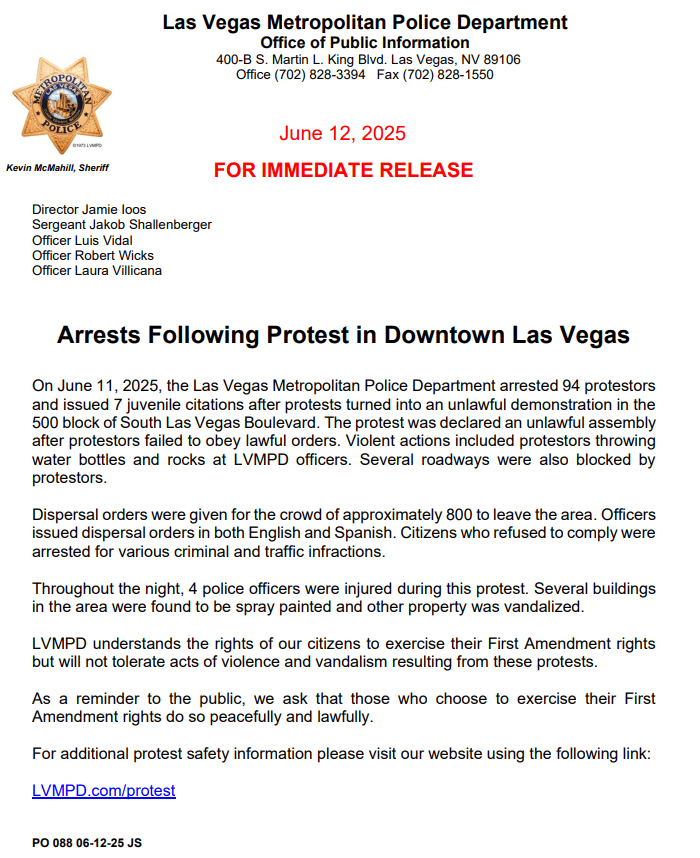
According to LVMPD’s press release, the protest—attended by an estimated 800 people—was declared an “unlawful assembly” after demonstrators allegedly threw rocks and water bottles, blocked roads, and ignored repeated dispersal orders issued in both English and Spanish. The department reported four officer injuries, along with vandalism to nearby buildings and property. A total of 94 arrests were made, alongside 7 citations issued to minors. LVMPD reiterated its support for First Amendment rights while maintaining a zero-tolerance stance on violence and vandalism.

However, multiple eyewitness accounts offer a conflicting perspective. Melony, one of the arrested protesters, described the event as “chill” and “full of good energy,” aside from an early altercation involving a man wearing a MAGA hat who allegedly attacked a demonstrator. Police did not intervene or arrest the man, raising concerns about selective enforcement from the outset. She stressed that the majority of the crowd was committed to nonviolence; she did admit seeing a few individuals throw water bottles, but emphasized that several other protesters actively intervened to prevent such actions. Importantly, she stated she had never heard any dispersal order before being tackled to the ground and arrested by a male officer, who also threw her personal belongings on the ground in the process. Despite her arrest, she did mention, “I was not mad at all before my arrest, I was even trying to help them by giving them their flashlight back while on my live feed.”
Once in custody, she was placed in a crowded holding area, where a detention officer allegedly spoke up, saying that the original plan had been to issue citations on site rather than proceed with mass arrests, largely due to concerns over jail overcrowding. She also described witnessing a woman who was detained but ultimately released without being processed, allegedly because the visible extent of her injuries, described as bloody might have reflected poorly on the department’s use of force. This incident has become a point of concern among activists, as accountability can decrease due to omission, and a lack of providing immediate medical attention as was reported by those arrested.
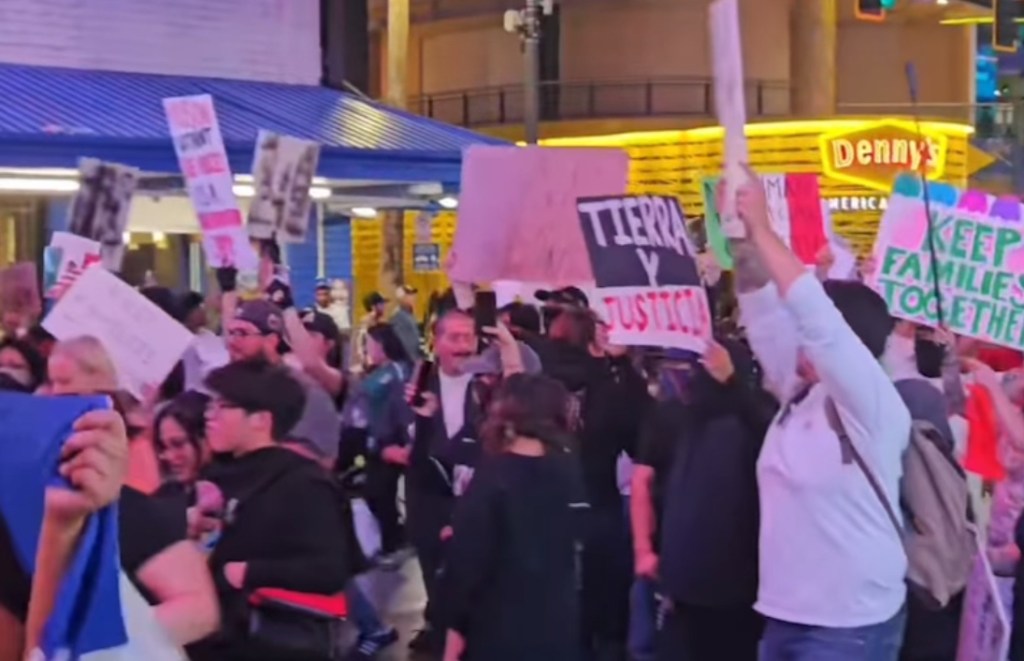
Miranda, another protester, echoed the concern about the lack of clear dispersal communication. “I was near the front and didn’t hear anything—just heard the message passed down from others,” she explained. She suggested that the sound system used by police was too weak to reach the large crowd, resulting in most people being unaware of any order to leave. Miranda did not witness anyone throwing rocks, despite that being a primary justification listed in the police report. Instead, she saw minimal tagging and standard protest behaviors like jaywalking. According to her, LVMPD’s online post declaring the protest unlawful was followed almost immediately by tear gas and rubber bullets—implying that the announcement may have been a procedural formality rather than a sincere effort to inform protesters.
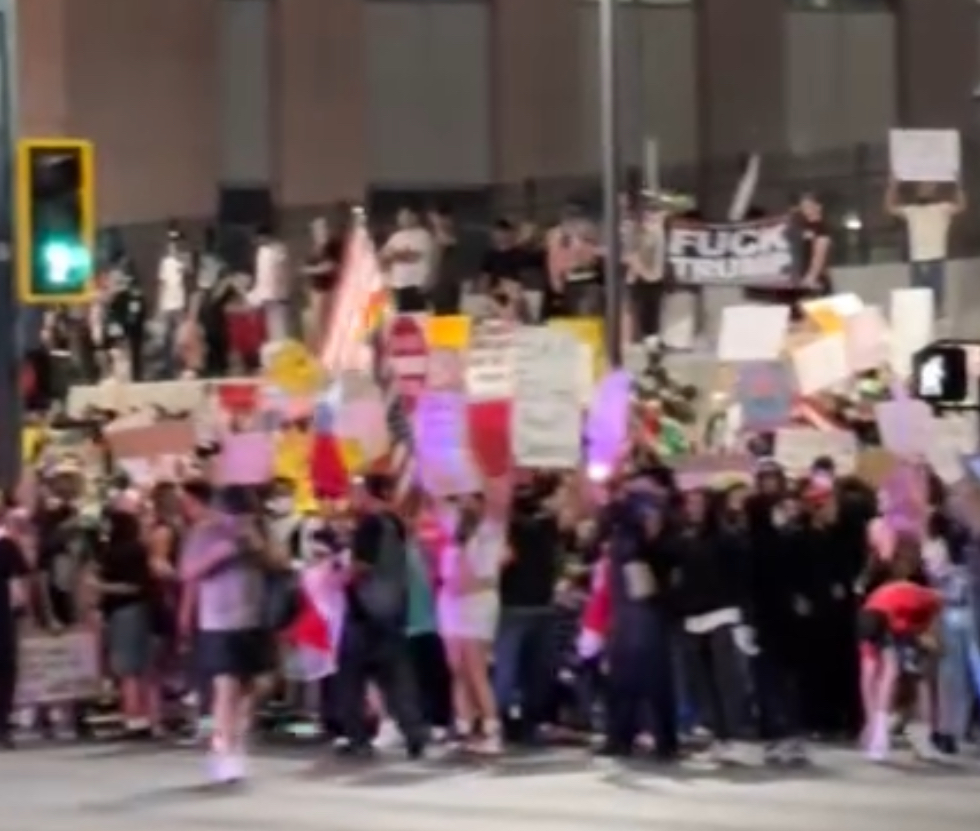
Kaytlin, a student from Nevada State University, added further clarity. She left the protest just 12 minutes before LVMPD posted their dispersal message on X and stated that she had not heard any orders to leave at that time. “I only started recognizing the dispersal announcement then—some people came in at this time and weren’t even aware of the incoming rubber bullets and tear gas,” she said. Her experience reflects a broader theme across witness accounts: a lack of audible warnings that would have given protesters a fair chance to comply before force was used.
Interestingly, despite LVMPD’s claim that four officers were injured, none of the three witnesses we reached out to reported seeing any officers hurt during the demonstration. All reported witnessing protesters being pushed, tackled, and detained—some roughly—but did not observe any police showing signs of physical harm. This discrepancy raises questions about when and how the alleged injuries occurred, and whether they were accurately represented in the department’s narrative. The only visible injuries described by witnesses were sustained by protesters, including the woman mentioned earlier.
As more witnesses come forward, the central issue gaining traction is the question of proportionality and transparency in law enforcement’s response to peaceful assembly. If dispersal orders were not heard or clearly communicated, and if the justification for force was based on actions seen only by police and not by numerous independent witnesses, public trust in LVMPD’s handling of the protest may continue to erode.
Summarizing the sentiment of what many have stated, “Everything was fine until the officers decided it wasn’t. They were the ones who escalated it.” These words underscore a broader concern regarding the intricate relationship between law enforcement practices and community trust. The phrase encapsulates a growing feeling among the public that their interactions with police could start peacefully but quickly deteriorate due to the aggressive tactics employed by officers.

3×3 Vinyl Sticker
$5.00

3×3 Vinyl Sticker
$5.00
These conflicting narratives expose the urgent need for a transparent, independent review of the June the 11 protest response. As footage and firsthand testimonies continue to surface, Las Vegas residents—and the nation—are left to grapple with a difficult question: Are law enforcement agencies using isolated incidents as convenient pretexts to justify widespread crackdowns?
Discover more from KVIG Informative
Subscribe to get the latest posts sent to your email.


 KVIG Informative