
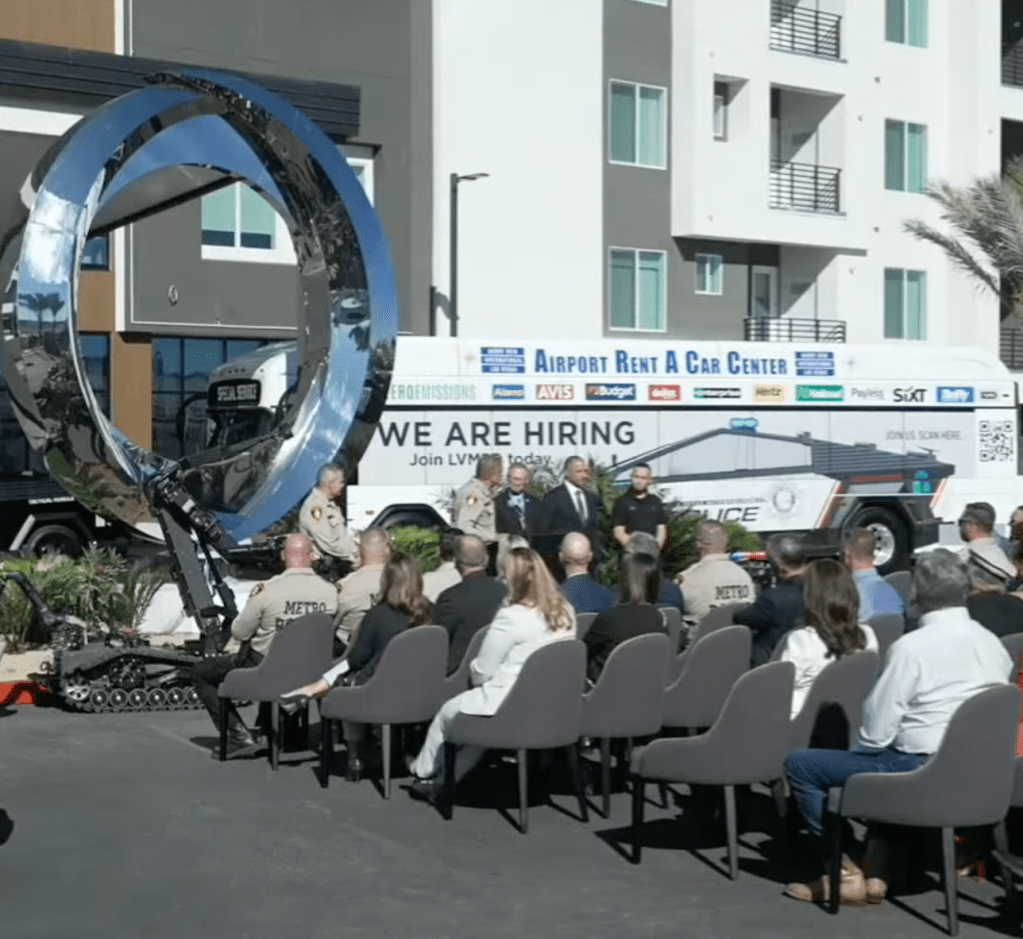
When Las Vegas Sheriff Kevin McMahill stood in the parking lot of the Otonomus Hotel to unveil a new fleet of Tesla Cybertrucks for patrol, he framed the moment as a simple win for taxpayers and officers alike.
“Not one taxpayer dollar went to buying these Cyber Trucks,” he told the small crowd, thanking Ben and Felicia Horowitz by name for covering the cost and promising the vehicles would make patrol work safer and more efficient.

The trucks, McMahill said, represent “innovation,” “sustainability” and “our continued commitment to serve this community with the best tools that we have available — safely, efficiently, and responsibly.”
That line — zero taxpayer expense — is exactly the rhetorical gift donors and police departments want to give one another. But the optics and the math tell a more complicated story: private capital is not merely paying for equipment.

It is underwriting a narrative about what “safety” looks like, who gets to set policing priorities, and how a city’s public institutions are shaped by a handful of wealthy actors.
This is not abstruse theory. The donors here are not anonymous. Reporting shows that Ben Horowitz — cofounder of the venture firm Andreessen Horowitz (a16z) — and his wife supported the Las Vegas department with multimillion-dollar gifts used to buy and outfit the Cybertrucks and other equipment.
McMahill singled them out on stage, calling their generosity the reason the department could adopt the vehicles “at zero expense to the taxpayer.”

3×3 Vinyl Sticker
Sliding scale $3.00-$8.00

3×3 Vinyl Sticker
Sliding scale $3.00-$8.00
The “gift economy” of modern policing
Police departments across the country increasingly accept private gifts: vehicles, drones, surveillance cameras, training stipends and more. On the surface donations can be framed as moral generosity or civic partnership.
In practice, they create recurring dependencies and subtly shift the frame of accountability. When donors fund police vehicles, equipment or specialized technology, those donors gain leverage — symbolic, reputational and sometimes operational — over how policing is presented and prioritized.
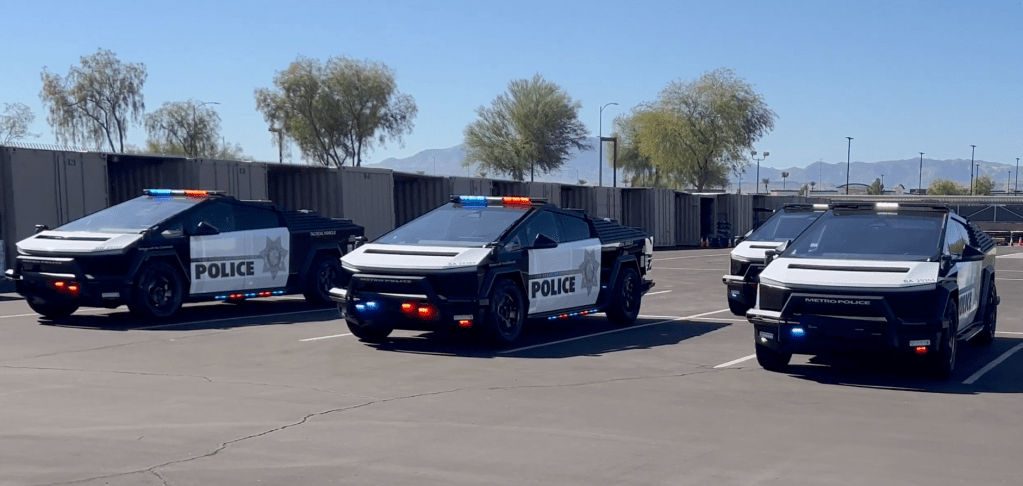
Las Vegas’s Cybertruck announcement crystallizes that dynamic. The rollout was staged at a luxury, AI-driven hotel founded by Philippe Ziade and accompanied by a visible list of corporate partners who upfitted, branded and wrapped the trucks.
McMahill thanked a commercial upfitter and local vendors, and placed the ceremony in a setting that advertises automation, surveillance and high-end technological spectacle. The spectacle matters: it ties a narrative of “innovation” to hardware that will operate in neighborhoods that already experience disproportionate policing.

3×3 Vinyl Sticker
Sliding scale $3.00-$8.00

3×3 Vinyl Sticker
Sliding scale $3.00-$8.00
Who gives, who benefits — and what are the conflicts?
The donors at the center of this story bring more than checks. Ben Horowitz is a household name in venture capital; his firm and its partners back companies that design surveillance hardware and software, and the founders have made major real-estate investments in the Las Vegas area.
The overlap matters: the same wealthy actors who finance policing infrastructure can also hold interests in local property markets and proptech firms — creating a feedback loop in which surveillance and real-estate value are mutually reinforcing.
In short: capital that benefits from rising property values can also finance the systems that police and control urban space.
That is not merely speculative. Recent academic and working-paper research finds that private donations to police can change police priorities and behavior.

3×3 Vinyl Sticker
Sliding scale $3.00-$8.00

3×3 Vinyl Sticker
Sliding scale $3.00-$8.00
Researchers using municipal data have documented cases where even modest private sponsorships correlate with measurable shifts in policing activity — raising questions about impartiality and the public interest when private money reshapes public discretion. Those are the structural risks that donations like this pose.

Technology is not neutral; neither is the setting
Sheriff McMahill emphasized officer safety and recruitment. He praised Tesla Cybertrucks as “high performance,” said they will carry ladders, shields and “less-lethal tools,” and called them a recruiting asset. Those are legitimate operational claims.
But the rhetorical frame — “most technologically advanced hotel on the planet” and “most technologically advanced police department on the planet” — also performs a cultural shift: it normalizes a future in which private tech aesthetics and private donors are central to civic life.

That matters because technology is not neutral. Where and how tools are deployed — drones, license-plate readers, armored vehicles — has effects on who is policed and how. When donors also have portfolio ties to surveillance tech or proptech, the question isn’t just whether the tools will work; it’s whose interests the tools will primarily serve.
Numerous reporting threads connect the dots between startup capital, surveillance hardware providers, and wealthy individuals buying influence in local civic conversations. The Las Vegas Cybertruck ceremony simply gives that process a highly visible stage.

The missing interlocutors
One striking element of the McMahill remarks is who does not appear onstage: residents most affected by intensive policing were not given a visible role in the narrative he offered.
The speech thanks donors, vendors and staff; it thanks an airport authority for a bus and a media firm for designs; it does not thank the communities that studies show are most surveilled or discuss safeguards, oversight, or independent data governance. That omission is not accidental.

A donor-driven model of procurement tends to center donors and vendors; community concerns about surveillance, data retention, and civil liberties too often become an afterthought.

3×3 Vinyl Sticker
Sliding scale $3.00-$8.00

3×3 Vinyl Sticker
Sliding scale $3.00-$8.00
What transparency and accountability should look like
There are modest, practical steps that could preserve the benefits of modern gear while guarding against influence and harm:
- Public disclosure of donations and any conditions attached, in accessible, searchable form.
- Independent oversight of donated tech — civilian review boards or auditors who can verify privacy protections and evaluate operational use.
- Strict data governance: who controls footage and sensor logs, how long they are kept, how much they cost and who can query them.
- Procurement safeguards that prevent vendor-capture (e.g., no sole-source deals that privilege donors’ portfolio firms).

Donations need not be banned. But when the city accepts millions in gifts for policing, the civic bargain should be explicit: donors fund hardware, but the rules of use, retention and oversight are set in public, not in boardrooms or staged ceremonies.

Why this matters beyond Las Vegas
Las Vegas is one of many cities where elite philanthropy or corporate gifts are changing policing. But the city also provides a useful case study: Andreessen Horowitz and its founders have been publicly visible in Las Vegas real estate and civic projects, and the Cybertruck donation is a clear instance where private capital, public safety, and local urban change collide.
The pattern — private money underwriting public functions without parallel public governance — is familiar. Recent research warns that this “gift economy” of policing can shift incentives in ways that exacerbate inequities rather than ameliorate them.

The question the public should be asking
Sheriff McMahill’s line — “Not one taxpayer dollar went to buying these Cyber Trucks” — is rhetorically powerful. But it is not the whole story. The public should expect answers to clear questions: Who gave what, and under what terms?
Do donors’ broader investments create conflicts of interest? How will data generated by these vehicles be stored, shared, and governed? Who will audit their use? And finally: who decided that the right face of public safety is a shiny armored EV wrapped in corporate vinyl?

If government is truly of, by and for the people, then gifts to public safety must be accompanied by public power: transparency, safeguards, accountability and meaningful community consent. Otherwise we risk a future where the shape of our streets — and the meaning of “safety” — is written outside public view.
Discover more from KVIG Informative
Subscribe to get the latest posts sent to your email.


 KVIG Informative