
When Minja Yan launched her campaign for Clark County Commission District F, she spoke of affordability, livability, and responsiveness. Her message was clear: “Fighting for a stronger, more affordable Clark County.” But beneath the surface of that message lies a network of roles and relationships that complicates the story.
Yan sits at the intersection of influence and access. She is executive director of the AAPI Chamber Foundation, a board member of the UNLV Lee Business School Alumni Chapter, active in the UNLV AAPI Alumni Affinity Club, and involved with the Urban Land Institute Nevada District Council.

3×3 Vinyl Sticker
Sliding scale $3.00-$8.00

3×3 Vinyl Sticker
Sliding scale $3.00-$8.00
Professionally, she holds a senior role at Millennium Commercial Properties, specializing in underwriting and real-estate development. Together, these positions place her at a crossroads of civic leadership, nonprofit influence, and private investment — a powerful position, but one that raises questions about whose voices and interests are prioritized when policy meets development.
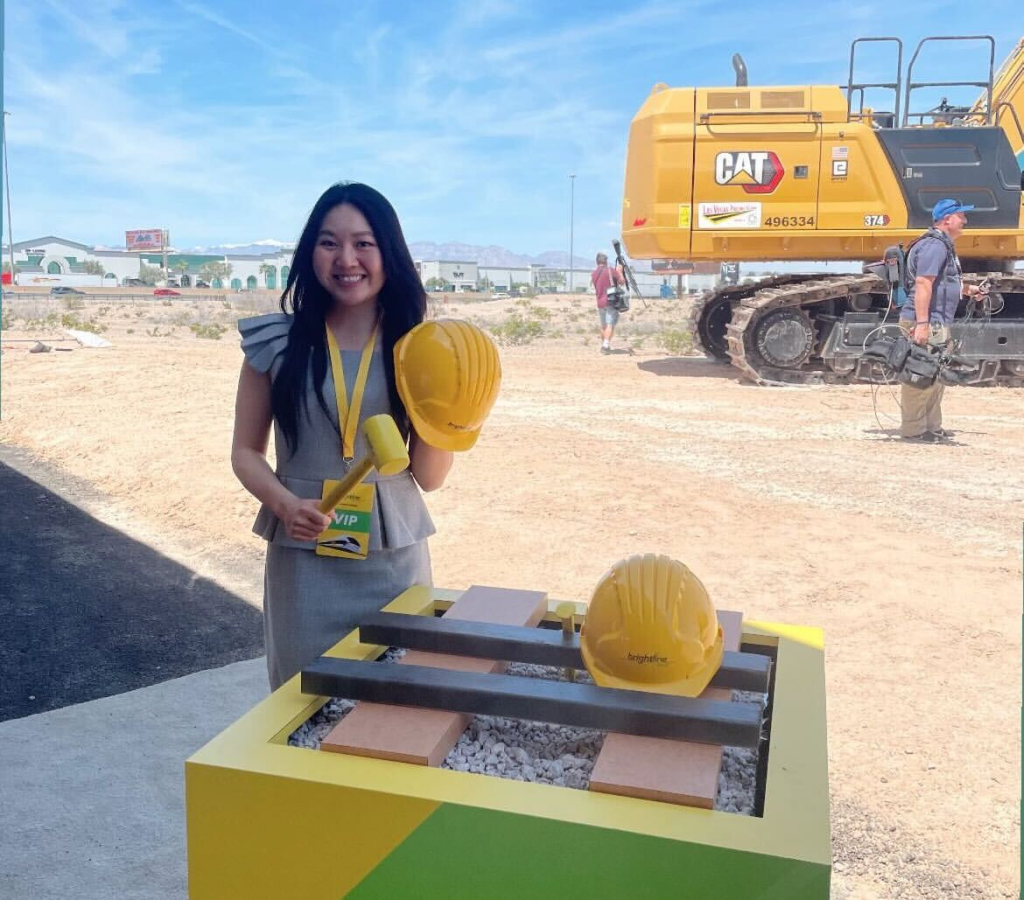
The appearance of a mural in Las Vegas’s Chinatown this summer brought those questions into sharp focus. KVIG Info asked Yan directly whether art, when tied to development, can serve as a tool of gentrification, displacing long-time residents under the guise of “community engagement.”
Yan’s response sidestepped the question. She noted that she had reached out to Clark County months before the mural went up but “never heard back,” and only learned the mural was finished through news coverage.
She emphasized her TEDx talk on placemaking and her general support for “community-driven engagement,” but she never directly addressed whether art projects tied to redevelopment might accelerate displacement.

This omission matters because the organizations Yan participates in do more than convene civic leaders. ULI Nevada brings together developers, investors, and planners. Alumni associations channel influence through institutional donors and legacy giving. The AAPI Chamber Foundation relies on corporate sponsorships.
None of these connections prove improper influence, but in neighborhoods like Chinatown, murals and public art often precede investment, rising rents, and displacement. Residents watching these patterns are left asking: When a candidate claims to champion “redevelopment without displacement,” how will that be ensured in practice?

Yan’s statements reflect awareness and intention, but they leave a gap. District F voters are left to reconcile her eloquent framing of community engagement with the reality that she did not answer the critical question about art and gentrification.
High-level support for placemaking is not the same as a commitment to concrete protections for residents, clear consultation processes, or transparency about her intersecting civic and professional roles.

The stakes in District F are not abstract. Growth, development, and cultural shifts are accelerating.
Public art, while celebrated, is also a signal — sometimes a precursor to investment that can displace long-standing communities. The question of accountability, transparency, and who benefits from development remains open.

3×3 Vinyl Sticker
Sliding scale $3.00-$8.00

3×3 Vinyl Sticker
Sliding scale $3.00-$8.00
Minjia Yan brings experience, networks, and a campaign message that resonates with many. But District F residents must look beyond the rhetoric.
They deserve clarity on how decisions about art, redevelopment, and neighborhood change will be made, whose voices will be prioritized, and how potential conflicts between civic leadership and private sector ties will be navigated.

Discover more from KVIG Informative
Subscribe to get the latest posts sent to your email.

 KVIG Informative