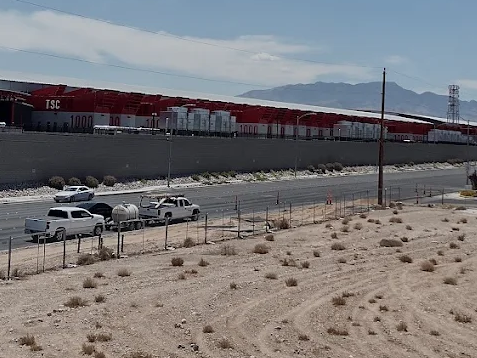
In December 2022, DigitalBridge Group and IFM Investors completed an $11 billion acquisition of Switch, the Las Vegas-based data center operator that runs some of the largest digital infrastructure campuses in the United States. The transaction pulled Switch off the New York Stock Exchange and made it a private company owned by infrastructure investment firms backed by Australian pension funds managing the retirement savings of millions of working people.
By September 2024, those same firms were exploring taking Switch public again — this time at a valuation of $40 billion, according to Reuters. That represents a nearly fourfold increase in value in less than two years, financed in part by Nevada’s water, subsidized by Nevada’s taxpayers, and built on land where water rights were secured through public-private agreements that transferred publicly owned effluent water to private industrial use.
The Tahoe Reno Industrial Center, which houses Switch’s Citadel Campus alongside Tesla’s Gigafactory, holds water rights to more than 4 billion gallons per year — a combination of groundwater and surface water from the Truckee River, according to Nevada Current reporting. In 2021, a 13-mile pipeline was completed that delivers an additional 4,000 acre-feet per year of treated wastewater from the Truckee Meadows Water Reclamation Facility in Sparks directly to the industrial park.
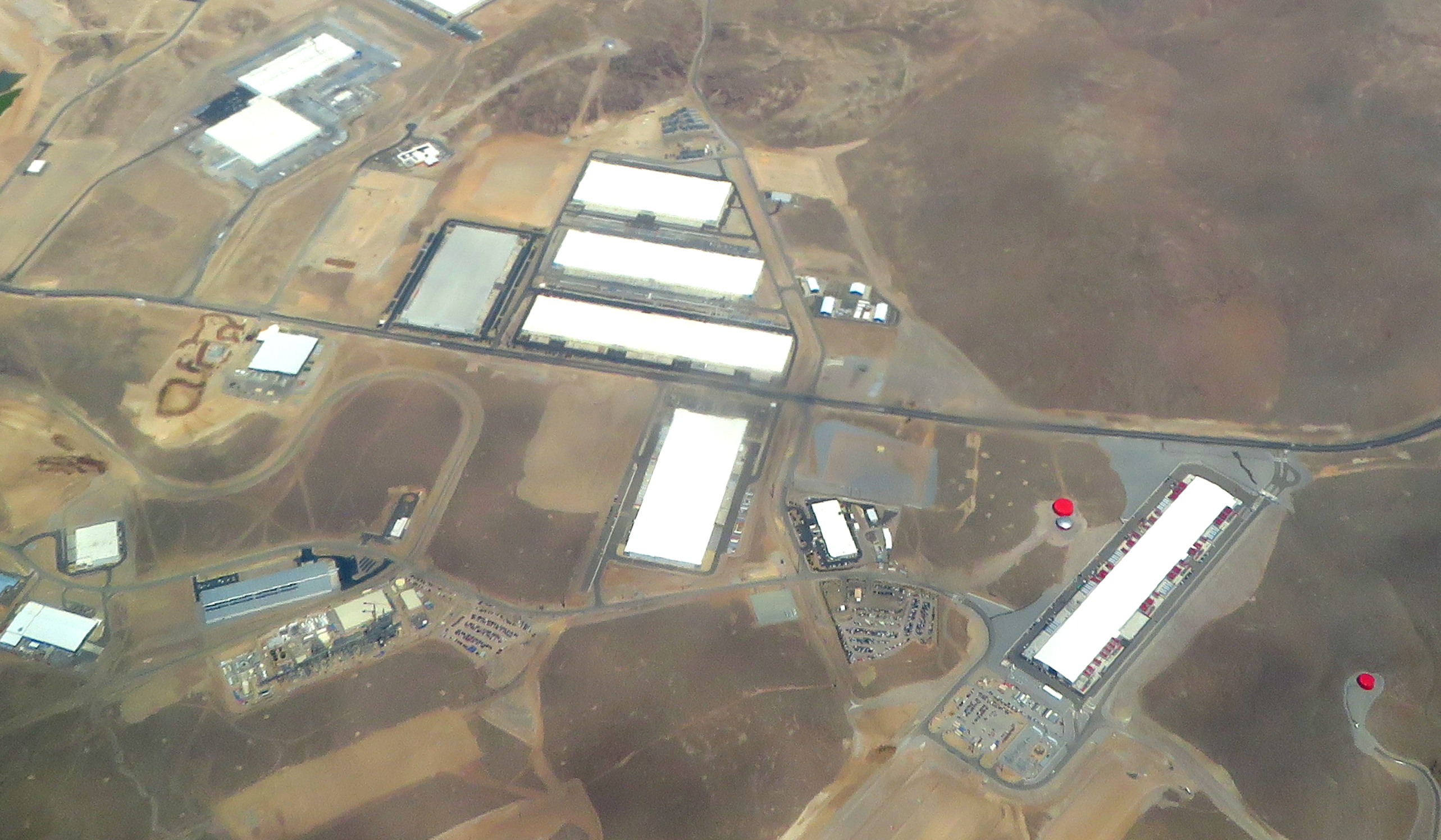
Under that agreement, the cities of Reno and Sparks effectively lease their municipal wastewater to the industrial center for 30 to 70 years. In exchange, the state and the industrial center provide the cities with equivalent water rights to maintain Truckee River stream flows. The companies pay a base fee for the treated wastewater and a premium during dry years when water is scarce.
By 2033, according to estimates by the Desert Research Institute, electricity generation for data centers at the Tahoe Reno Industrial Center could require nearly 12,450 acre-feet of water annually. Direct cooling for the facilities could require an additional 9,600 acre-feet per year. The water consumption projections reflect the scale of expansion planned for the site, which Switch markets as having the capacity for up to 17.4 million square feet of data center space and gigawatts of power upon full build-out.
Switch’s Las Vegas Core Campus currently encompasses approximately 2 million square feet with 275 megawatts of power capacity. The company operates additional campuses in Grand Rapids, Michigan; Atlanta, Georgia; and Austin, Texas. Its clients include Nvidia, Dell Technologies, FedEx, PayPal, and entities tied to billionaire Peter Thiel, founder of the surveillance technology company Palantir, according to Switch’s own public marketing materials.
IFM Investors, one of the two firms that purchased Switch, is owned by a group of Australian pension funds and manages approximately AU$199 billion — roughly $132 billion — on behalf of retirees. In July 2023, Aware Super, Australia’s third-largest pension fund with 1.1 million members and $150 billion under management, invested an additional $500 million into Switch. Aware Super publicly stated that Switch’s 100 percent renewable energy operations align with its investment philosophy as a responsible operator of real assets.


DigitalBridge, the other acquiring firm, is a Florida-based infrastructure investment manager that oversees a $50 billion portfolio of digital assets including data centers, cell towers, fiber networks, and edge infrastructure on behalf of institutional investors. The firm’s CEO, Marc Ganzi, has described the data center sector as constrained by limited land and power capacity in key markets — conditions that drive up valuations for operators who control large parcels with secured utility access.
Nevada provides those conditions. According to Nevada Current, the state allocates $139 million annually in public subsidies for data centers. Companies receive sales and use tax reductions of 2 percent, a 75 percent reduction in personal property tax, and zero state income tax. Switch promotes these incentives on its website alongside its access to renewable power priced at 4.9 cents per kilowatt-hour.

3×3 Vinyl Sticker
Sliding scale $3.00-$8.00

3×3 Vinyl Sticker
Sliding scale $3.00-$8.00
The Tahoe Reno Industrial Center sits within a U.S. Qualified Opportunity Zone, a federal tax designation that allows investors to defer capital gains taxes on profits reinvested in designated low-income census tracts. The industrial park spans 107,000 acres — larger than the city of Reno — and was developed by Lance Gilman, a Storey County commissioner who has publicly stated that the water will help meet demand for manufacturing and data storage.
In 2019, the Nevada State Engineer denied nine applications to expand the industrial center’s groundwater use, determining that no water remained available to appropriate in the Truckee River basin. An attorney for the industrial park told the Nevada Independent at the time that the denial would have no impact on water supply, as those applications had not been factored into the center’s resource plans. The industrial park relied instead on the effluent pipeline and existing rights.
Data centers require water for two primary functions: cooling the equipment that generates enormous heat, and generating the electricity used to power the servers. A single data center can consume as much energy as an entire city, according to a Massachusetts Institute of Technology study. Northern Nevada, already home to Switch, Tesla, and Novva, is projected to become one of the largest data center markets in the world.

When DigitalBridge and IFM purchased Switch in 2022, the companies stated that the acquisition would allow them to scale Switch’s business domestically and internationally to meet enterprise demand for mission-critical digital infrastructure. IFM’s Global Head of Infrastructure, Kyle Mangini, said the deal aimed to deliver returns to investors and maximize the retirement savings of millions of working people the pension funds represent.
Two years later, the value had nearly quadrupled. The water rights remain. The subsidies continue. And the Australian retirees who financed the deal stand to profit from a public resource secured through agreements with Nevada municipalities and industrial developers in one of the driest states in the nation.
Discover more from KVIG Informative
Subscribe to get the latest posts sent to your email.


 KVIG Informative