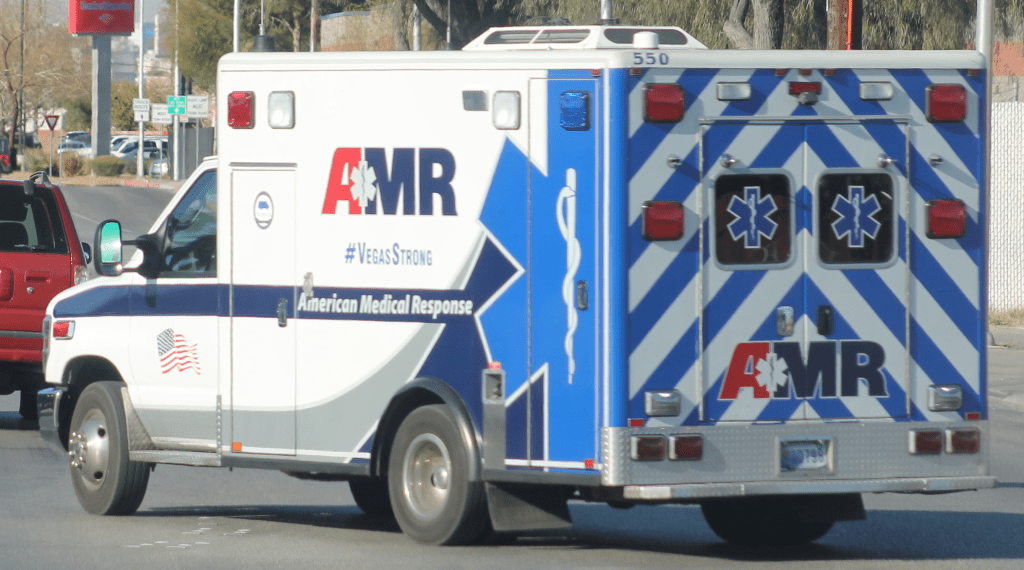
When someone in Las Vegas calls 911, the ambulance that arrives is owned by Wall Street.
American Medical Response and MedicWest Ambulance — the two private companies that hold franchised emergency ambulance contracts with the city of Las Vegas, North Las Vegas, and Clark County — are both subsidiaries of Global Medical Response, a Texas-based medical transportation conglomerate owned by Kohlberg Kravis Roberts, the New York private equity firm that became synonymous with 1980s corporate raiding after its $25 billion leveraged buyout of RJR Nabisco inspired the book Barbarians at the Gate.
KKR bought AMR in 2018 for $2.4 billion and combined it with Air Medical Group Holdings to form Global Medical Response. The transaction was financed primarily with borrowed money. According to SEC filings and S&P Global Ratings, that dealmaking left GMR with more than $4.3 billion in debt — $3.7 billion in term loans and $600 million in senior notes — all of which came due in 2025.
As of mid-2023, GMR’s bonds were trading at 55 cents on the dollar among institutional investors, according to Bloomberg. In April 2023, S&P Global Ratings downgraded GMR’s debt to CCC+ — junk status. The ratings agency stated that GMR’s capital structure is unsustainable over the medium to long term.
In April 2024, KKR announced a debt restructuring plan that required more than 80 percent of existing lenders and bondholders to accept longer-dated debt and $948 million in new preferred stock in exchange for pushing out the maturity dates. The deal has not eliminated the underlying financial strain.
In 2023, KKR owned two major healthcare companies that filed for bankruptcy: physician staffing giant Envision Healthcare and oncology provider GenesisCare. According to a report from the nonprofit Private Equity Stakeholder Project, KKR also owns three other companies that are “distressed and carry heightened risk for default” — Covenant Physician Partners, Global Medical Response, and One Call Corporation.
The financial pressure shows up in the public record. In 2022, AMR failed to meet the contractual 90 percent on-time response benchmark every single month in the city of Las Vegas, according to city data. One of the contract requirements mandates that ambulances arrive at the scene of the most pressing emergencies within 12 minutes, 90 percent of the time on a monthly average. MedicWest missed the benchmark only one month that year. Community Ambulance, a third provider that covers some calls including those on the Las Vegas Strip, exceeded the requirement all year.
In November 2023, the Las Vegas City Council extended AMR’s franchise agreement by one year and MedicWest’s by two years. The contracts had been set to expire. Councilman Brian Knudsen, who proposed shortening AMR’s extension from two years to one, told the council he wanted to see data over the next year to continue assessing the company’s performance. Councilwoman Olivia Diaz supported the shorter window, citing instability in fire department leadership and a lack of consistent oversight.
North Las Vegas extended MedicWest’s contract — as the city’s sole ambulance provider — through 2026 and took over dispatch duties in an effort to improve response times. Clark County redrew coverage maps in 2023, shifting some 911 calls from AMR and MedicWest to Community Ambulance in areas where the private equity-backed companies had struggled to meet benchmarks.
The structure is not unique to Southern Nevada. According to ProPublica and the American Prospect, private equity firms now control the majority of the U.S. ambulance market. AMR is the largest ground ambulance provider in the country. GMR, through its Air Medical Group Holdings subsidiary, controls two of the three air ambulance companies that hold 67 percent of the national air medical transport market.
Between 2010 and 2014, the median price for air ambulance services doubled from $15,000 to $30,000, according to a 2017 Government Accountability Office report. Private equity-owned ambulance companies have been cited in investigations for ambulances in disrepair, failing equipment, and understaffed operations. In 2013, Rural Metro Fire — later acquired by GMR — filed for bankruptcy after Warburg Pincus, another private equity firm, bought it in 2011. Formal complaints during that period included a lack of ambulances, county-imposed penalties for late responses, and at least one canceled contract following a late response that may have contributed to a death.
The Private Equity Stakeholder Project’s 2024 report on healthcare bankruptcies stated that private equity firms’ aggressive debt-funded growth strategies threaten the stability of critical healthcare resources across the country. In 2023, 17 of 80 healthcare bankruptcies — 21 percent — involved companies owned by private equity. That figure more than doubled the number from 2019.
Southern Nevada fire departments operate their own ambulances but rely on AMR and MedicWest to meet the volume of 911 calls. According to Global Medical Response’s own public statements, the two companies respond to an average of 74,000 emergency calls per year in Las Vegas alone. AMR operates more than 450 paramedics and EMTs locally. MedicWest employs approximately 350.
Las Vegas Fire Chief Fernando Gray told the city council during the November 2023 contract extension hearing that the city needs franchise agreements with private ambulance companies to keep up with demand. Without them, the public fire departments cannot cover the workload.
The Oregon Public Employees Retirement Fund is an investor in KKR North America Fund XI — the entity that owns Global Medical Response — according to public pension records. Oregon PERS has $25 billion invested in KKR and similar private equity funds, representing 27 percent of its $93 billion portfolio. Seeking higher returns than stocks and bonds provide, the pension fund helped finance KKR’s purchase of AMR. If GMR defaults or files for bankruptcy, Oregon’s public employees and retirees stand to lose part of that investment.
When the ambulance is late, the public bears the cost. When the company goes under, the pension fund takes the loss. But when KKR bought AMR, collected management fees, and leveraged the company into billions of debt, the private equity firm kept the profit.
Discover more from KVIG Informative
Subscribe to get the latest posts sent to your email.

 KVIG Informative