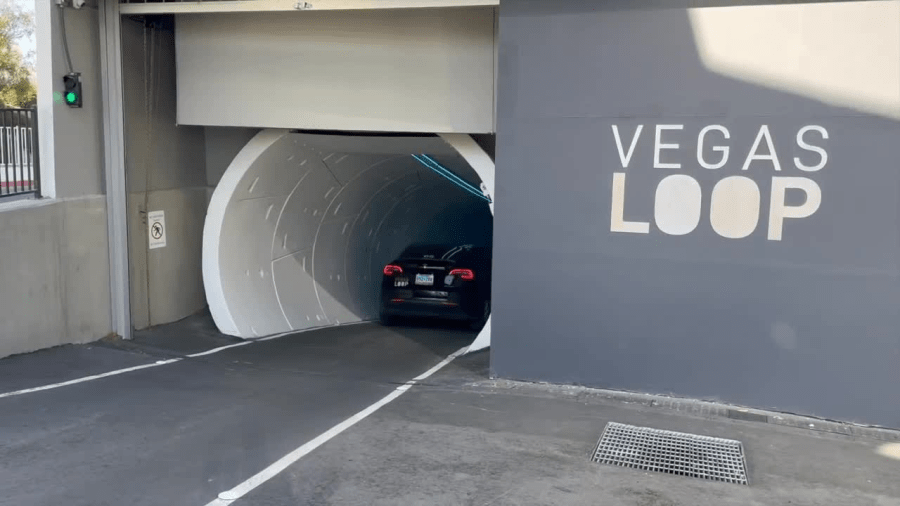
In May 2019, the Las Vegas Convention and Visitors Authority awarded a $48.7 million contract to Elon Musk’s Boring Company to build an underground tunnel system beneath the Las Vegas Convention Center. Construction began six months later. What followed over the next five years was not simply the arrival of a new transit technology — it was the structured replacement of a public-serving system with a privately owned one, enabled step by step through bankruptcy, franchise agreements, and the quiet elimination of a non-compete clause.
The Las Vegas Monorail opened in July 2004 as a privately financed elevated rail line running 3.9 miles along the east side of the Strip. Built using $650 million in state-backed bonds, the system never came close to its projected ridership. Organizers estimated 19 to 20 million riders annually. Peak ridership reached 7.9 million in 2007. By 2022, that number had dropped to 4.3 million.
The monorail filed its first Chapter 11 bankruptcy in 2010 after failing to cover bond payments. A federal judge rejected its reorganization plan in 2011, writing that the company was asking the court to let it “float along until it sinks.” The debt was eventually reduced from $658 million to $13 million. The system emerged from that bankruptcy but remained financially fragile.
When the COVID-19 pandemic forced the monorail to close in March 2020, the system could not survive. Facing expenses and zero income from ridership, the Las Vegas Monorail Company filed for Chapter 11 bankruptcy again in September 2020. In December 2020, the LVCVA — the same agency that had just hired The Boring Company — purchased the monorail’s assets for $24.26 million, with approximately $22 million going to bondholders. For context, the system had cost $650 million to build. The purchase price represented a 96 percent discount.
The Non-Compete That Disappeared
The significance of the LVCVA purchase went beyond the price. The monorail had operated under a non-compete clause that legally prevented any other transit company from building a competing system in the same corridor along the Las Vegas Strip. When the LVCVA acquired the monorail’s assets, that clause was eliminated.
National outlets noted at the time that the purchase “could clear the way for an expansion of Loop” by removing the restriction that had blocked The Boring Company from operating in the same area. The LVCVA board formally approved the elimination of the non-compete zone as part of the acquisition — the same board that had already contracted with The Boring Company the year before.
The Vegas Loop Expands
The Boring Company’s Vegas Loop opened at the convention center in June 2021. The system uses Tesla vehicles driven by company employees to shuttle passengers through 1.7 miles of tunnel connecting three stations. The LVCVA pays The Boring Company $4.5 million annually to operate the system — which equates to roughly $7.50 per ride on top of the $5 day pass passengers pay. Reporting has suggested the company may be subsidizing operations to keep customer prices low.
In October 2021, Clark County Commissioners approved a 50-year franchise agreement allowing The Boring Company to build, own, and operate a 52-stop system covering 16 miles in the Resort Corridor, with planned connections to Allegiant Stadium, the Brightline West rail station, and UNLV. The company funds construction entirely with private capital, though individual properties pay for stations built on their land.
In June 2022, the Las Vegas City Council unanimously approved a separate franchise agreement allowing tunnels beneath downtown. The combined approvals now total 68 miles of tunnel and 104 stations spanning the Strip, downtown, the airport, and UNLV. As of early 2026, approximately 3.5 miles are operational with stations at the convention center, Encore, Resorts World, and Westgate.
Safety Violations and Fines
The Boring Company’s expansion has not proceeded without controversy. In April 2024, the National Council for Occupational Safety and Health named The Boring Company’s Vegas work among the “Dirty Dozen” worst workplace safety offenders in the United States. Workers have reported chemical burns from waste material generated by the tunneling process, and firefighters must decontaminate their equipment after conducting rescues from project sites.
In May 2025, Nevada’s occupational safety agency fined the company $400,000 after two firefighters suffered chemical burns during a training exercise in Loop tunnels. The fines were rescinded the following day following a meeting between Boring Company president Steve Davis and high-ranking state officials, according to reporting from the Nevada Current. In October 2025, the company was fined nearly $500,000 for dumping apparent drill fluid into the Clark County Water Reclamation District sewer system beginning in April 2025.
The Monorail’s Uncertain Future
The monorail, meanwhile, continues to operate under LVCVA ownership. In 2023, the system recorded its highest ridership during the Formula One Las Vegas Grand Prix weekend and carried its 100 millionth passenger in November. Ridership has recovered to approximately five to six million annually since reopening in May 2021.
In May 2025, LVCVA CEO Steve Hill announced $12 million in new funding to keep the monorail operational through 2035. Hill has acknowledged, however, that the manufacturer of the monorail’s Bombardier Mark VI train cars went out of business, and replacement parts are no longer being produced. When the system’s current supply of parts runs out, the monorail cannot continue. Hill has indicated that once the monorail reaches the end of its operational life, The Boring Company is interested in purchasing the infrastructure and repurposing the elevated track corridor as part of the Vegas Loop network.
LVCVA CFO Ed Finger has stated publicly that no public transportation system in America operates without public subsidization — a framing that positions The Boring Company’s privately funded model as the natural successor. The transition from a publicly bonded, community-serving transit system to a 50-year private franchise was not the result of a single decision. It was assembled piece by piece: a contract in 2019, a bankruptcy in 2020, a non-compete eliminated, and franchise agreements stretching half a century into the future.
The Boring Company did not compete for Las Vegas. It was invited in — by the same authority now responsible for what comes next.
Discover more from KVIG Informative
Subscribe to get the latest posts sent to your email.

 KVIG Informative