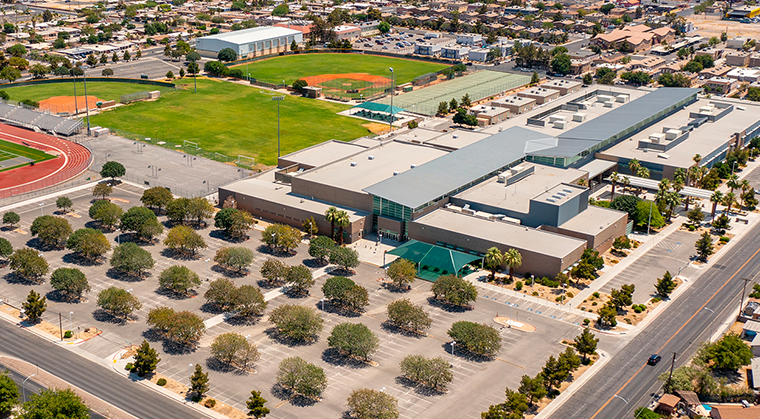
Stan Armstrong remembers the day a Rancho High School coach grabbed him by the shirt, threw him into an equipment room, and locked the door. Outside, police helicopters circled overhead. Students shouted. Officers screamed. Armstrong, trapped inside, could hear everything.
When the noise stopped, the coach returned, walked Armstrong onto a school bus, and sent him home. Armstrong was Black. The year was somewhere between 1967 and 1972. The violence was routine enough that Armstrong cannot remember which riot it was.
Students at the time joked about riot season. Some thought of it as fun. Others describe it as one of the great regrets of their lives. Between 1967 and 1974, Rancho High School in North Las Vegas became the epicenter of racial violence so severe that the National Guard opened a substation on campus, positioning officers on the roof with shotguns. Police on Harley-Davidsons patrolled the hallways. A student suffering from leukemia died after being Maced during one confrontation. During another, a rock-throwing student hit a police helicopter and forced it to make an emergency landing at J.D. Smith Middle School.
Armstrong documented the violence in a 56-minute film released in 2012 called The Rancho High School Riots. The documentary, hosted by actor Antonio Fargas, focuses on the class of 1971, which experienced the height of the unrest. Riots occurred once or twice a year during the seven-year period, according to the film.
Among those interviewed were local basketball star and former Memphis Grizzlies head coach Lionel Hollins, All-America center Lee Gray, former Black Panther members Kenny and Greg Porter, one of the school’s first Black cheerleaders Louise Randall, white athlete Danny Grey, former principal Larry Olsen, and Assemblyman Harvey Munford, who was a teacher at Rancho during the riots.
The violence did not emerge from a vacuum. Las Vegas earned the nickname the Mississippi of the West during the 1930s and 1940s, when the city enforced segregation policies that rivaled the Jim Crow South. According to UNLV Professor Tyler Parry, Mayor Ernie Cragin forced Black business owners downtown to relocate west of the railroad tracks in the 1930s or lose their business licenses. Housing covenants barred Black residents from purchasing homes anywhere else in the city.
By the 1940s and 1950s, the West Las Vegas neighborhood, known as the Westside, had become a vibrant community of Black-owned businesses, clubs, and gathering places. But the infrastructure lagged behind the rest of the city. Many streets lacked plumbing, electricity, or pavement. Black residents could work in the casinos on the Strip only in back-of-the-house positions. They could not be seen or heard. Even famous Black performers like Pearl Bailey and Nat King Cole could not stay in the same hotels where they performed.
In 1960, the NAACP declared Las Vegas the fifth worst Jim Crow area in the nation. That same year, publisher Hank Greenspun brokered a desegregation agreement at the closed Moulin Rouge Hotel, securing promises from Strip resorts that they would accept Black guests. The agreement ended formal segregation, but it did not end economic inequality or institutional discrimination.
Nevada prohibited school segregation by law in 1872. But as Martin Dean Dupalo, a former UNLV political science instructor, told a 2014 panel discussion, that was just on paper. Clark County schools remained segregated by circumstance because nearly all Black residents lived in the Westside. In a 1968 lawsuit, the 9th U.S. Circuit Court of Appeals ruled that the Clark County School District’s bifurcated school policy was principally responsible for aggravating racial segregation in elementary schools.
Rancho High School drew students from the Westside, from white North Las Vegas neighborhoods, and from families working at Nellis Air Force Base. Most students were poor. Armstrong described the school as a true urban campus. It was also, according to historians, a microcosm of the racial tension gripping the nation during the late 1960s and early 1970s. Students went home every night to news coverage of the assassination of Martin Luther King Jr., race riots in Detroit and Watts, and the fight for civil rights.
Black students wanted to be part of that progress, Assemblyman Harvey Munford said during the 2014 panel. A lot of angry Black students were on campus, Armstrong said. A lot of them had a misguided anger. The violence being pushed from outside the school made its way into the classroom. Black Panthers came onto campus. White students formed a group called BUCK, Brothers United Caucasian Klan. Michael Brophy, a white student who remembers being part of BUCK, was caught in class when a riot broke out.
In one documented incident, North Las Vegas police boarded a school bus full of Black Rancho students and Maced everyone on board. In another, police pulled over a taxicab near the Westside on Oct. 5, 1969. Gerald Davis, a young Black man working on his mother’s car nearby, approached the vehicle to calm the situation. A Black officer named Robert Arrington followed him. The confrontation escalated into what became known as the West Las Vegas Uprising, a three-day period of unrest that drew national attention to police brutality and economic inequality in the city.
At Rancho, the violence continued for years. Teachers walked on eggshells, according to Munford. Lee Gray, the All-America basketball player, was described by Armstrong as a gentle giant who physically stood between his friends to prevent harm and stop escalation. Terry Davis, a white student who graduated in 1971, said he and many Black students had grown up together and played sports together. But during the riots, peer pressure and mob mentality took over. You did not dare turn down a fight because your friends would call you a coward, Davis said. It was one of the great regrets and great shames of his life.
Lefty Mott, another classmate, told students at a 2019 screening of the documentary at Rancho that some participated in the fighting because it was fun.
A student with leukemia died after being Maced during one of the riots. His name is not widely documented in public records, but his death is acknowledged in panel discussions and in the documentary as one of the most tragic outcomes of the violence.
By 1974, the riots had subsided. Rancho High School continued operating. The National Guard withdrew. The police helicopters stopped circling. But the scars remained. In 2014, forty years after the last major riot, a panel of former students gathered at the Clark County Government Center to reflect on what had happened. Some spoke freely. Some joked. Many had grown, they said.
Armstrong told students in 2019 that he made the documentary to ensure the history would not be forgotten. He sees parallels between then and now. The racial tensions that defined the late 1960s and early 1970s have not disappeared. They have evolved.
The Westside remains one of the most disenfranchised areas of Las Vegas, according to UNLV Professor Tyler Parry. Redlining, institutional neglect, and economic inequality persist. The same problems that existed in 1969 still exist today, Parry said in a 2024 interview. The Westside represents that original problem in Las Vegas.
The riots at Rancho High School were not an isolated incident. They were the logical outcome of decades of segregation, economic disparity, and institutional failure. The students who lived through them carry the memory of what happens when a society refuses to reckon with its foundational inequities. Some call it riot season. Others call it the price of trying to integrate a city built on exclusion.
Discover more from KVIG Informative
Subscribe to get the latest posts sent to your email.


 KVIG Informative