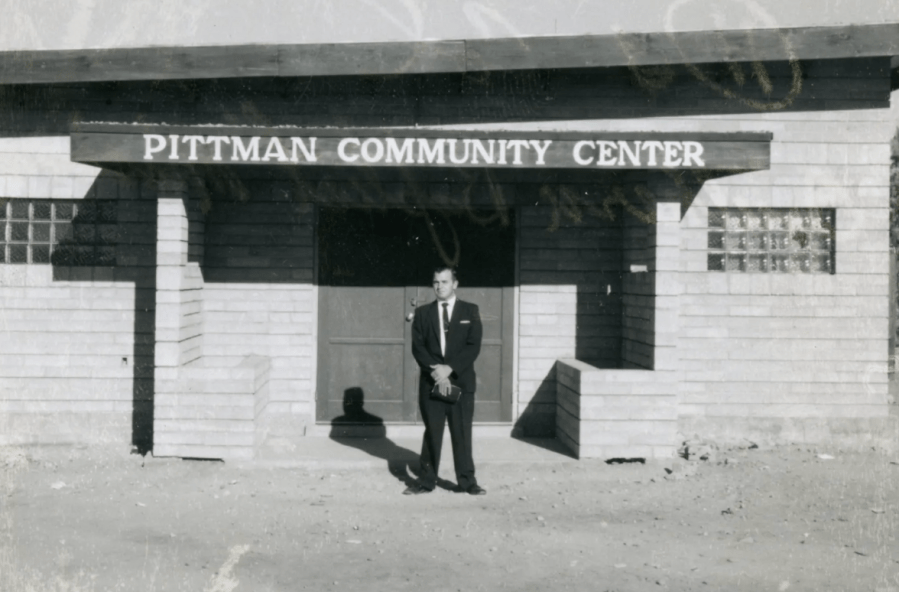
In 1917, three men discovered manganese in the Mojave Desert eight miles from what would become Henderson. They called the mine Three Kids. The material went into weapons and equipment during World War I. When the war ended a year later, demand collapsed and the site went quiet.
B.R. Jefferson, one of the mine’s founders, decided to develop land eight miles west. The Pittman Act had recently passed, named after Nevada Senator Key Pittman. Under the law, settlers could claim land by digging a well and bringing in crops. Jefferson did both. The town that grew around that effort carried the senator’s name.
For the next 25 years, Pittman developed independently. According to Mark Hall-Patton, retired museum director for the Clark County Museum, residents owned their property outright. They organized a Women’s Club. They numbered their streets and created a mail delivery system. They built the Swanky Club at 920 N. Boulder Highway and the Midway Casino. Workers from the nearby magnesium plant came to Pittman to eat and drink.
Henderson Nearly Disappeared
Eight miles away, another town was rising. During World War II, the federal government selected a site near the Three Kids Mine to build one of the largest magnesium plants in the world. Basic Magnesium Inc. broke ground in 1941. At its height, the plant employed 13,000 workers. The federal government built housing, a bowling alley, a theater, a hospital, and restaurants. The workers called their town Basic Townsite. In 1943, residents dedicated a post office and named it in honor of U.S. Senator Charles B. Henderson, who had financed the plant’s construction.
The war ended in 1945. The plant shut down. Three-quarters of the workers left. Henderson nearly disappeared. According to Hall-Patton, Pittman kept going. The residents had a sense of themselves as their own community. They were doing just fine.
Henderson’s Problem
By 1953, Henderson faced a structural problem. The town wanted to incorporate as a city, but it did not have enough residents to maintain services or generate tax revenue. Clark County had been extending services to the area, but those arrangements were set to expire in July. All the land in Henderson had been owned by Basic Magnesium, not by the people who lived there, according to Hall-Patton. The federal government had sold off the housing and infrastructure after the war, but Henderson still lacked a stable population base.
Henderson’s representatives turned to Pittman. The town that predated Henderson — that had property owners and an established identity — was asked to merge. According to Hall-Patton, Henderson was in a poor bargaining position. Pittman held the leverage. But the pressure came anyway. Under that pressure, Pittman’s residents agreed to become part of the new City of Henderson. The deal gave Pittman one seat on the city council.
The decision, Hall-Patton said, would ultimately lead to Pittman’s fall to obscurity and Henderson’s rise to the second-largest city in Nevada.
What Pittman Got
Pittman did not die immediately. Its restaurants and clubs stayed open for years. But over time, the name faded. The streets remained, but the identity dissolved. Today, Pittman exists as a neighborhood within Henderson. Most residents do not know its history. The annexation gave Henderson the population base it needed to incorporate. The incorporation gave Henderson the ability to grow.
Hall-Patton told local press in December 2024 that Pittman residents in the early 1950s thought of themselves as being in Henderson, except they were in Pittman. That distinction mattered to them. They had built something. They owned it. When the annexation came, they were told they would have a voice. They got one seat on the council. The name disappeared from maps within a generation.
Henderson Is Doing It Again
Seventy years later, Henderson is annexing again. In March 2025, the city council approved annexation of 38.48 acres of Bureau of Land Management property. The city describes the move as necessary for residential and commercial growth. In recent years, Henderson has annexed hundreds of acres in Eldorado Valley to the southeast, designated as industrial land for logistics, warehousing, and advanced manufacturing.
The city calls it the global business district. Companies including Amazon, Kroger, Levi’s, DIV Industrial, and Overton Moore Properties have acquired land there. Haas Automation is building a 2.4 million square foot machine manufacturing facility. A West Henderson Hospital opened in December 2024. Station Casinos is planning another property in Inspirada, a master-planned community west of Anthem.
Henderson’s economic development office markets the city’s annexation capacity as a competitive advantage. The city’s comprehensive plan, Henderson Strong, aligns with the regional Southern Nevada Strong plan to ensure Henderson qualifies for state and federal funding for infrastructure. In 2024, the city received approval from the state Department of Education to become a public charter school sponsor, giving the city control over new schools independent of Clark County School District.
Some residents in newly annexed neighborhoods have complained that annexation brings unwanted changes in governance, taxation, and development plans, according to reporting from late 2024. Critics argue that people living in annexed areas feel their interests are not represented by the city council and that they are being forced into more expensive or restrictive policies. Zoning changes sometimes follow annexation, altering neighborhood character by introducing commercial development or higher-density housing.
Henderson’s population has grown from fewer than 20,000 in 1970 to more than 330,000 today. The city is the second-largest in Nevada, behind only Las Vegas. U-Haul ranked it among the top 20 fastest-growing cities in America in 2024. The city won the Malcolm Baldrige National Quality Award — the highest federal recognition for performance excellence — the same year. Mayor Michelle Romero said in an April 2025 interview that economic vitality is one of Henderson’s five strategic priorities and that the city has a bold vision to achieve it.
Pittman had a vision too. It involved land, ownership, and independence. In 1953, Henderson needed people. Pittman had them. The merger was sold as partnership. What Pittman got was a seat at the table and a slow fade into obscurity. The city that absorbed it now carries a new name for the same process: annexation for economic vitality. The pattern repeats. The land gets redrawn. The people who lived there before lose the name they called home. The city that grows calls it progress.
Discover more from KVIG Informative
Subscribe to get the latest posts sent to your email.


 KVIG Informative