
With testament to Albert Einstein’s visionary theories, an international team of scientists has recently uncovered fresh evidence of gravitational waves—ripples in the fabric of our universe influenced by colossal events, such as the collision of black holes.
Gravitational waves, initially theorized by Einstein in 1915 and later confirmed by the ground-based LIGO observatory in 2015, represent disturbances in the fabric of time itself. The recent discovery, emerging from the North American Nanohertz Observatory for Gravitational Waves (NANOGrav), funded by the National Science Foundation, demonstrates the more widespread existence of these waves at much longer wavelengths.

To understand gravitational waves, one can visualize space-time as a form of Jell-O, with massive objects causing ripples as they move through it. Jeffrey Hazboun from Oregon State University likens it to a wave passing through a cube of Jell-O, causing compression and expansion.
The scientific significance of this discovery lies in its ability to unveil a cosmic hum of gravitational waves across vast distances. While the LIGO observatory was akin to Galileo’s telescope pointing at Jupiter, this new endeavor involves more sophisticated telescopes examining longer wavelengths, providing insights into the background hum of gravitational waves.
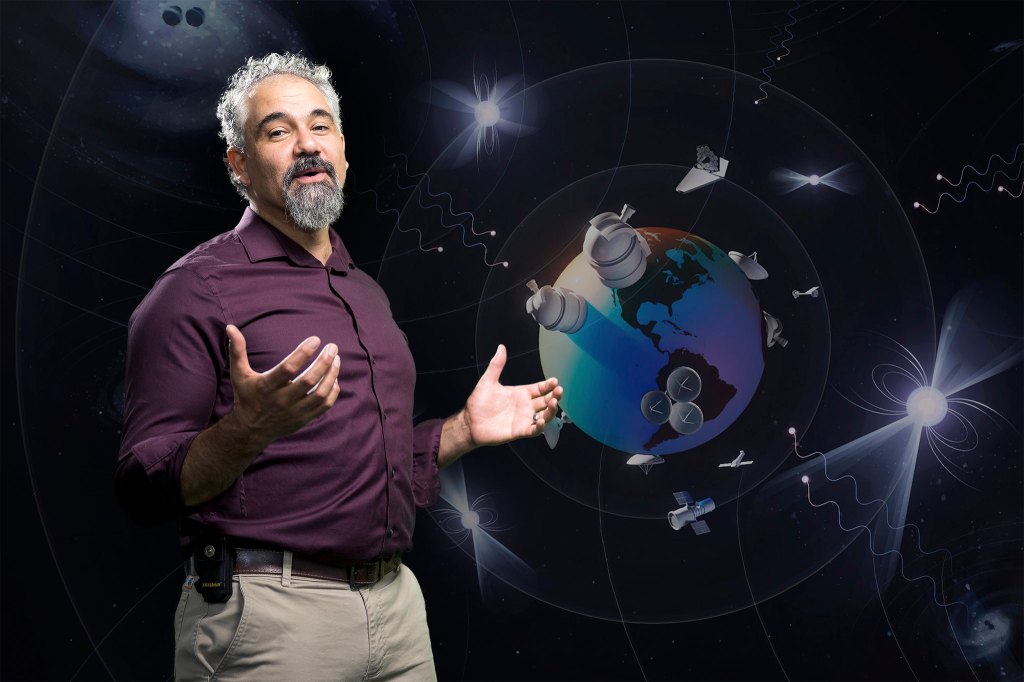
NANOGrav, in operation for 15 years, employed pulsar timing arrays, utilizing pulsars—predictable, dead stars with rotating beacons. By monitoring 68 pulsars with radio observatories, scientists detected subtle changes indicative of gravitational waves.
The origins of these gravitational waves are speculated to involve supermassive black holes, potentially millions of them, within the centers of galaxies. As galaxies merge, these black hole binaries emit gravitational waves, creating the observed ripples in the fabric of time.

Tap Image To Purchase
3×3 Vinyl Sticker
$5.00

Tap Image To Purchase
3×3 Vinyl Sticker
$5.00
Looking ahead, scientists aim to delve deeper into the cosmic symphony by identifying specific sources of these gravitational waves. By studying individual contributors, such as bouncing supermassive black holes, researchers hope to unravel the mysteries of the universe’s formation and trajectory, turning the hum of the cosmos into a cosmic archaeological record.
Discover more from KVIG Informative
Subscribe to get the latest posts sent to your email.


 KVIG Informative