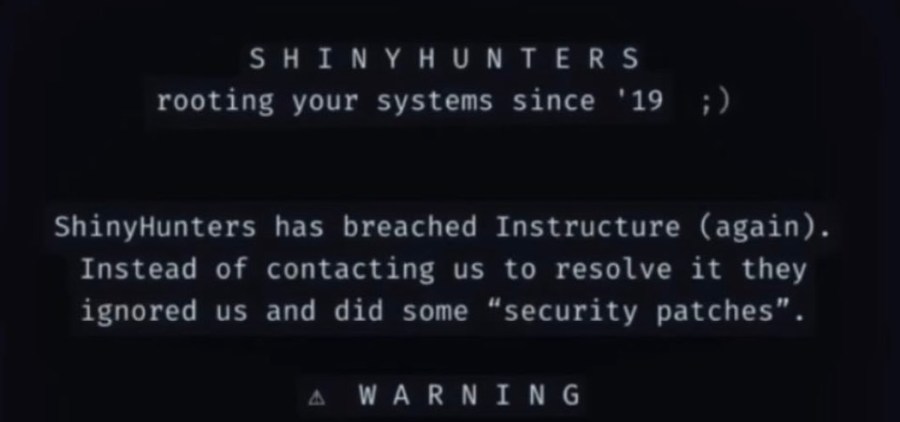
On May 7, 2026, a criminal hacking group calling itself ShinyHunters replaced the Canvas login page used by the Clark County School District and UNLV with a ransom demand. Canvas is owned by Instructure. Instructure is owned by KKR. The same firm that streams your kid’s Friday night football game, processes the ticket, tracks the stats, sells the uniform, and now holds the private messages and student IDs of hundreds of thousands of Nevada students was breached twice in eight days and told the schools it had been fixed. It had not.
Students attempting to log into Canvas across Nevada were redirected to a page they did not expect. It read: “ShinyHunters has breached Instructure (again). Instead of contacting us to resolve it they ignored us and did some ‘security patches.’ WARNING: If any of the schools in the affected list are interested in preventing the release of their data, please consult with a cyber advisory firm and contact us privately.” The deadline for Instructure to pay or negotiate was May 12. The data threatened for public release included names, email addresses, student ID numbers, and private messages from up to 275 million students, teachers, and staff at nearly 9,000 institutions worldwide.
The Clark County School District confirmed it was affected and advised students and staff not to attempt to log in. The Nevada System of Higher Education issued a statement describing it as a vendor issue involving Instructure and clarified that the breach did not originate within any NSHE institution. UNLV sent a notification warning students not to click any links in suspicious messages.

Help fund our archive
Sliding scale $3.00-$8.00

Keep the lights on
Sliding scale $3.00-$8.00
None of those statements mentioned KKR. They did not need to. Most people in Nevada have no idea that the company managing the breach is a $744 billion private equity firm with investments touching nearly every corner of the state’s daily life. The Canvas hack is the most visible evidence of that presence so far. It is not the only one.
How KKR Bought Into Nevada’s Classrooms
Instructure was founded in 2008 by two Brigham Young University graduate students. Canvas launched in 2011 and grew to become the dominant learning management system in North American higher education, used by approximately 41 percent of higher education institutions on the continent and deployed in K-12 districts across the country. Instructure went public in 2015, was taken private by Thoma Bravo in 2020, and was acquired by KKR in June 2024 for approximately $4.8 billion.
Canvas is now used by the Clark County School District, the fifth-largest school district in the United States, and by UNLV, UNR, and other institutions within the Nevada System of Higher Education. When CCSD students submit assignments, message teachers, take quizzes, or access grades, that activity flows through a platform owned by KKR. The student IDs, email addresses, names, and private messages at risk in the ShinyHunters breach are the data of Clark County students and Nevada university students.
The breach was not the first. ShinyHunters had claimed in September 2025 that it accessed internal files from the University of Pennsylvania through a Canvas-mediated access path. Instructure confirmed on May 6 that the situation had been resolved. By noon on May 7, students were reading ransom demands where their login screen had been.
Instructure was named as a defendant alongside KKR in a federal class action lawsuit filed in the Southern District of New York on May 8. At least six additional suits were filed in federal court in Utah. The suits allege negligence in the protection of student data. KKR declined to comment.

Your support keeps this work going

3×3 Vinyl Sticker
Sliding scale $3.00-$8.00
The Sports Pipeline: From Friday Night Lights to the Arena
The Canvas breach is the newest layer of KKR’s Nevada presence. The oldest and most pervasive runs through youth sports. KKR’s investment in PlayOn Sports gave the firm a stake in the NFHS Network, the streaming platform that holds live broadcast rights to NIAA high school athletic events across Nevada. Football, basketball, volleyball, soccer, track, softball, lacrosse, and state championship events all require a monthly or annual subscription to access.
The same PlayOn umbrella owns GoFan, the digital ticketing platform required for NIAA events at many Nevada high schools, charging a convenience fee on every transaction. It owns MaxPreps, acquired from CBS Sports in February 2025, which tracks the statistics, rosters, schedules, and rankings of every Nevada high school athlete in every sport. It owns VidSwap, which processes game film and performance analytics for coaches and programs.
In August 2024, KKR completed a separate $4.75 billion acquisition of Varsity Brands, the parent company of BSN Sports, the largest team dealer and online outfitter for athletic equipment in the United States. If a Clark County high school football program buys helmets, pads, or practice gear through the largest national supplier, that purchase goes to a KKR company.

3×3 Vinyl Sticker
Sliding scale $3.00-$8.00
3×3 Vinyl Sticker
Sliding scale $3.00-$8.00
What the Full Map Looks Like
Assemble the Nevada footprint. KKR owns the platform that CCSD students use to submit assignments and message teachers, and that platform has now been breached twice in eight days. It owns the streaming service that Nevada parents need a subscription to watch their children compete in postseason high school athletics. It owns the ticketing platform that processes entry fees at Nevada high school events. It owns the database that tracks every Nevada high school athlete’s statistics. It owns the largest national supplier of athletic uniforms and equipment to Nevada programs. It has invested in the commercial infrastructure that will drive professional soccer expansion into Nevada. It is pending approval to hold minority stakes in professional sports franchises across every major American league, including the NBA that is actively considering a Las Vegas expansion team.
KKR manages $744 billion in assets globally, has 568 portfolio companies, and has completed more than 300 acquisitions. Its Nevada presence was not built through a single transaction. It was assembled piece by piece, each acquisition described in press releases as empowering communities, creating opportunities, and delivering value to fans and families.
The Canvas breach makes the connection visible in a way that press releases do not. A student at UNLV trying to access finals materials on May 7 was not thinking about private equity. She was thinking about her presentation and the ransom demand on her screen. The firm that owns the screen, the platform, the data, and the deadline is the same firm that owns the app her cousin used to buy a ticket to watch her brother’s basketball game, the service that streamed the state championship, the database that tracks her younger sibling’s soccer stats, and the company bidding to bring a professional soccer league to the city where all of them live.
KKR has not issued a public statement about the Nevada impact of the Canvas breach. Instructure has not disclosed how many CCSD students or NSHE users had data exposed. Whether Instructure pays, negotiates, or allows the data to be released publicly will determine what happens next to information that belongs to Nevada’s students, not to any private equity firm.
Discover more from KVIG Informative
Subscribe to get the latest posts sent to your email.