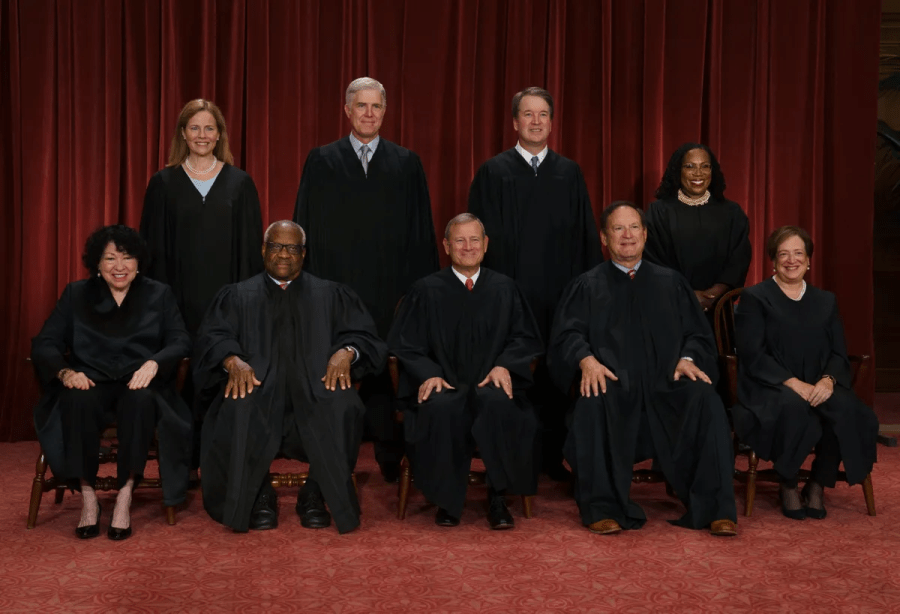
A unanimous Supreme Court threw out a $1 billion jury verdict against Cox Communications on March 25, ruling that internet service providers cannot be held liable for what their subscribers download. The decision rewrites the rules of online copyright enforcement and, in the view of two justices, quietly dismantles a law Congress spent decades building.
Over a roughly two-year period, Sony Music Entertainment and other major record labels sent Cox Communications more than 163,000 notices identifying IP addresses on Cox’s network that had been used to download or share copyrighted music without permission. Cox sent warnings to the account holders. It suspended some. It terminated 32 for infringement. During the same period, Cox terminated hundreds of thousands of accounts for nonpayment.
Sony did not sue those 32 terminated subscribers, or any of the others. Sony sued Cox. A jury awarded Sony and its co-plaintiffs $1 billion in statutory damages, finding Cox had willfully contributed to the infringement of more than 10,000 copyrighted works.
On March 25, 2026, a unanimous Supreme Court threw out that verdict. The decision in Cox Communications, Inc. v. Sony Music Entertainment, 607 U.S. ___ (2026), holds that an internet service provider cannot be held liable for the copyright infringement of its users simply because it knew infringement was occurring on its network. For an ISP to be liable, the Court ruled, it must have intended for its service to be used for infringement. Cox, the majority found, did not.
How the Case Got Here
The dispute stretches back more than a decade. In 2015, BMG Rights Management and Round Hill Music sued Cox in the Eastern District of Virginia, arguing that Cox’s repeat-infringer termination policy was too lenient to qualify for protection under the Digital Millennium Copyright Act, a 1998 law that shields ISPs from secondary liability when they implement reasonable anti-piracy policies. A jury awarded $25 million. The Fourth Circuit affirmed that Cox’s policy fell short of DMCA standards but threw out the verdict due to faulty jury instructions, sending the case back for a new trial.
Sony and other major labels joined the renewed lawsuit. MarkMonitor, a company specializing in intellectual property enforcement, ran software continuously scanning peer-to-peer file-sharing networks for infringement, tracing activity to specific IP addresses, identifying the ISP, and sending automated notices. More than 163,000 such notices went to Cox in the claim period. Cox’s own employees, according to Sony’s evidence at trial, expressed frustration at the volume of notices and an unwillingness to terminate paying subscribers over infringement complaints. One internal email, which became something of a signature exhibit in the case, included the phrase “F the DMCA.”
A jury sided with Sony, awarding $1 billion. The Fourth Circuit kept the contributory infringement finding in place, reasoning that knowingly continuing to provide internet service to identified infringers was sufficient to establish liability. Cox appealed to the Supreme Court, and the Court agreed to hear the case.
What the Court Decided
Justice Clarence Thomas wrote for seven members of the Court. The opinion rests on a straightforward premise: secondary liability for copyright infringement requires intent. A provider is contributorily liable only if it intended its service to be used for infringement. That intent can be proven in one of two ways. First, a provider induces infringement by actively encouraging it through specific acts, such as marketing a product as a piracy tool, as the software companies in the 2005 Grokster case had done. Second, a service is tailored to infringement when it is not capable of substantial or commercially significant uses that do not infringe.
Cox met neither standard. The Court found no evidence that Cox encouraged its subscribers to pirate music. To the contrary, Cox prohibited infringement in its subscriber contracts, issued warnings, suspended accounts, and terminated some users entirely. And Cox’s internet service, the majority noted, is used for an enormous range of lawful purposes. Providing a broadband connection is not the same as providing a piracy tool.
The Fourth Circuit, the majority wrote, had invented a third path to liability that does not exist in the law: knowledge alone. The lower court had held that supplying a product with knowledge that the recipient will use it to infringe is sufficient. The Supreme Court rejected that standard as an expansion of liability beyond what prior precedent supports, and reversed.
Cox stated after the ruling: “This opinion affirms that internet service providers are not copyright police and should not be held liable for the actions of their customers.”
The Concurrence’s Warning
Justices Sonia Sotomayor and Ketanji Brown Jackson agreed Cox should win, but refused to join the majority’s reasoning. In a concurring opinion, Sotomayor argued the majority had gone further than necessary, artificially closing off other potential theories of secondary liability that existing precedent had left open, including common-law aiding and abetting.
Sotomayor’s deeper concern was structural. The Digital Millennium Copyright Act was passed in 1998, 14 years after the Court first recognized that the Copyright Act implicitly allows for secondary liability. Congress designed the DMCA’s safe harbor as a bargain: ISPs that implement reasonable repeat-infringer termination policies receive protection from liability. The assumption embedded in that structure was that ISPs without such policies faced real legal risk. The majority’s ruling eliminates that risk regardless of what an ISP does or doesn’t do.
She put it plainly: after the majority’s decision, ISPs face no realistic probability of secondary copyright liability, whether or not they take any steps to address infringement on their networks. Cox’s own attorney acknowledged at oral argument that Cox would have no liability risk based on knowledge alone. Sotomayor noted that this renders the DMCA’s safe harbor provisions largely academic. Congress did not enact that framework, she wrote, just so the Court could empty it.
At oral argument, Sotomayor had asked whether the Court was being forced to choose between two extremes, and had pressed both sides on the workability of their proposed rules. Her concurrence makes clear she believed a middle path existed and that the majority declined to look for it.
What It Means Going Forward
The immediate practical effect is that Cox owes Sony nothing. The $1 billion verdict is gone. The case is remanded for further proceedings consistent with the opinion, though with contributory liability foreclosed and vicarious liability already thrown out by the Fourth Circuit, there is little left for Sony to pursue against Cox under current law.
The broader effect extends well beyond this case. The Supreme Court, on order, vacated a Fifth Circuit ruling against Grande Communications in a similar lawsuit brought by major music labels, directing the Fifth Circuit to reconsider under the new framework from Cox. Other ISPs facing secondary liability suits are likely to benefit from the same standard.
Legal analysts have pointed to potential downstream implications for AI developers, cloud platforms, and other technology intermediaries. The Court’s emphasis that providing a general-purpose service with knowledge that some users will misuse it is not enough for liability tracks closely with arguments being raised in AI copyright disputes, where copyright holders are attempting to hold model developers responsible for outputs that reproduce protected works. Whether Cox’s reasoning extends that far will be tested in lower courts.
The DMCA’s notice-and-takedown apparatus, the system by which rights holders send removal requests to platforms and ISPs, also faces new questions. If ISPs no longer face meaningful secondary liability for ignoring infringement notices, the legal incentive to process those notices at scale is diminished. Copyright holders now face the prospect of returning to a strategy the music industry largely abandoned more than a decade ago: suing individual infringers one at a time.
Sony and the recording labels have not announced a response strategy. The Recording Industry Association of America has called for Congress to clarify the law. Whether that effort gains traction in a legislative environment where ISPs, technology platforms, and digital infrastructure companies carry substantial lobbying power is an open question.
Discover more from KVIG Informative
Subscribe to get the latest posts sent to your email.