The Supreme Court ruled unanimously on April 17 that Chevron can move a Louisiana coastal damage lawsuit from state court to federal court, citing the company’s World War II military fuel contracts. A $745 million jury verdict against Chevron remains on appeal. Thirty-one other lawsuits over Louisiana’s vanishing coastline are still pending.
Louisiana is losing a football field of coastal wetland every 83 seconds, according to the U.S. Fish and Wildlife Service. Since 1932, more than 2,000 square miles of the state’s coastline have disappeared into the Gulf of Mexico. The canals dredged by oil and gas companies to move equipment and pipe across the marshes are among the documented causes of that loss. Saltwater follows the canals inland, killing freshwater marsh vegetation. The land collapses. The Gulf advances.
In 2013, Plaquemines Parish and other coastal Louisiana parishes filed 42 state-court lawsuits against oil and gas companies, seeking to hold them accountable for decades of damage under a 1978 state environmental law. The parishes wanted their day in Louisiana courts, before Louisiana juries. The companies wanted federal court.
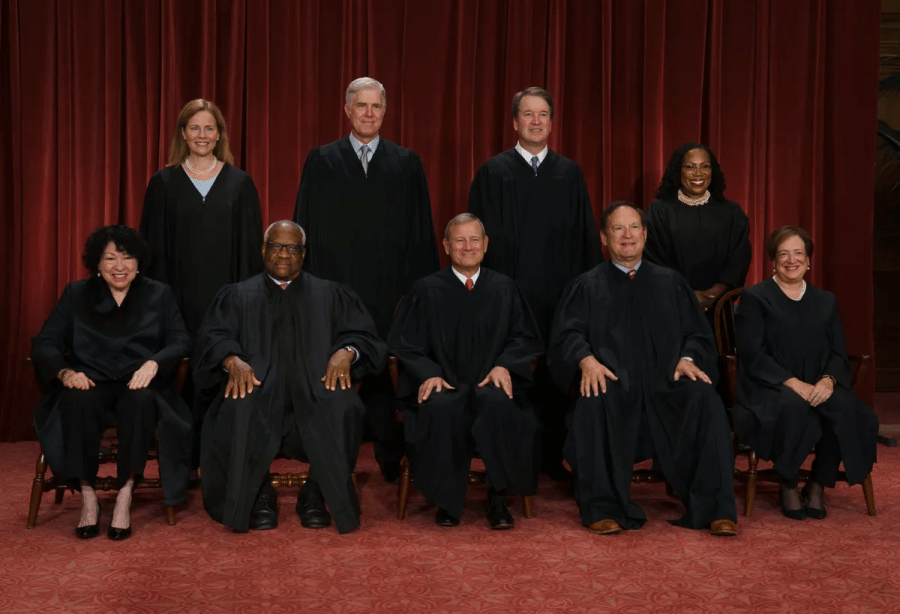
On April 17, 2026, the Supreme Court handed the oil industry a procedural victory in that fight. The 8-0 ruling in Chevron USA Inc. v. Plaquemines Parish, 608 U.S. ___ (2026), holds that Chevron can move its case from state to federal court by invoking the federal officer removal statute, because the company’s wartime crude oil production in the Louisiana marshes was closely connected to its World War II military contract to refine aviation gasoline for the U.S. military. Justice Samuel Alito did not participate, as he owns stock in a parent company of one of the defendants.
The ruling is procedural. It does not decide whether Chevron damaged the Louisiana coast or owes money for that damage. Those questions go back to a federal court, where the company expects a more favorable environment.
What Was Being Sued Over
In April 2025, the first of the 42 lawsuits went to trial. A Plaquemines Parish jury found Chevron liable for decades of coastal damage traced to its predecessor company, Texaco, and awarded the parish $745 million. The funds, by law, must be used for coastal restoration. The verdict was described by Columbia University’s Sabin Center for Climate Change Law as one of the largest ever won by a local government for environmental damage globally.
The jury’s finding rested on the parish’s allegation that Chevron’s predecessor had violated Louisiana’s coastal resources law by operating without permits and by using methods that caused outsized damage. Specifically, the parish alleged that the company dredged canals instead of building roads, used vertical drilling techniques that maximized production at the cost of environmental integrity, and stored waste in earthen pits rather than steel tanks. The parish argued those choices, made as far back as the 1940s, set in motion land loss that continues today.
Chevron immediately appealed. The company had spent years before that trial arguing the case never belonged in state court at all.
The Wartime Argument
Chevron’s path to the Supreme Court ran through World War II. During the war, the federal Petroleum Administration for War directed American oil companies to dramatically increase the production of aviation gasoline, or avgas, the high-octane fuel that powered combat aircraft. By 1944, the U.S. military required 636,000 barrels of avgas per day, up from roughly 4,000 barrels per day at the start of U.S. involvement in the war.
Chevron’s predecessor, the Texas Company, contracted with the federal government to refine crude oil into avgas at its Texas refinery. The contract required working around the clock to quadruple refining capacity. The federal government identified the Delta Duck Club oil field in Plaquemines Parish as a source of crude oil particularly well-suited to avgas refining, and classified it as critical to the war program. Some of the crude Chevron produced in Plaquemines Parish went directly to its own avgas refining operation.
Chevron argued before the Supreme Court that the parish’s lawsuit, which targets the specific extraction methods used at those wartime fields, including the canals, the vertical drilling, and the earthen pits, cannot be separated from its performance of a federal military contract. Because the federal officer removal statute allows defendants who were acting under federal direction to move cases to federal court, Chevron argued the lawsuit belongs in federal jurisdiction.
The Fifth Circuit had rejected that argument. The lower court found that because Chevron’s refining contract did not specifically direct how to acquire or produce crude oil, the extraction activities were not covered by the statute. Judge Andrew Oldham dissented, arguing crude oil was indispensable to avgas and that its production necessarily related to the federal contract.
What the Court Decided
Justice Clarence Thomas, writing for seven justices, sided with Oldham’s logic. The opinion holds that the phrase “relating to” in the federal officer removal statute is broad, requiring only that the challenged conduct bear a close connection to the performance of federal duties, not that the federal contract specifically directed that conduct.
The majority found Chevron had established that close connection. The crude oil from the Plaquemines Parish fields was essential feedstock for the avgas refining contract. The federal government itself had identified those fields as critical to the war effort. The drilling methods the parish now challenges, vertical drilling, canals, earthen pits, were exactly the methods that maximized wartime crude production in compliance with federal directives, including a federal regulation requiring vertical drilling to maximize output and a directive to preserve steel that made earthen pits standard practice. The government adjusted the price it paid for avgas based on the cost of obtaining crude oil.
The Court rejected Louisiana’s counterargument that the removal statute requires a defendant to have been acting under federal authority in the specific activities being challenged. That reading, Thomas wrote, would collapse two distinct elements of the statute into one and leave the “relating to” language without independent meaning. The ordinary rules of statutory construction forbid reading a law in a way that makes part of it redundant.
Justice Ketanji Brown Jackson concurred in the judgment but disagreed with the majority’s reasoning. She argued the statute requires a causal connection between the federal duties and the challenged conduct, and that the majority’s looser “indirect relationship” standard goes further than the text and legislative history support. In her reading, Congress added “relating to” in 2011 only to clarify that pre-suit discovery proceedings against federal officers were removable, not to broaden the standard for ordinary civil cases. She agreed Chevron satisfies even the stricter causal-nexus test, so the result is the same.
What This Does and Does Not Do
The ruling applies to roughly 11 of the 42 pending coastal damage lawsuits, those involving defendants with wartime federal fuel contracts, according to John Carmouche, the trial attorney who secured the $745 million Plaquemines verdict. The other 31 cases remain in state court and are unaffected by the decision.
The $745 million verdict itself is not overturned by this ruling. It remains on appeal. The Supreme Court ruling adds another layer to that appeal, as Chevron can now argue the entire state-court trial was conducted in the wrong forum. Whether a federal court would order a new trial on that basis, or apply the existing verdict, will be determined in the appellate proceedings.
Louisiana Attorney General Liz Murrill, who joined the coastal damage cases as a plaintiff after taking office in January 2024, said she remains confident the outcome will be the same in any court. “A jury in one of the most conservative, pro-oil communities in the country found that Chevron was liable for billions of gallons of toxic waste dumped into the Louisiana marsh,” she said in a statement. Carmouche told reporters that his team intends to pursue the affected cases in federal court as aggressively as the others remain in state court.
The Louisiana Mid-Continent Oil and Gas Association called the ruling a step toward what it described as the appropriate legal forum, saying the coastal lawsuits “never belonged in state court.” Louisiana’s $50 billion coastal master plan had counted on the wave of coastal damage verdicts as a potential funding source. That timeline is now less certain for the cases that have moved to federal jurisdiction.
The land keeps disappearing regardless of which court hears the case. Current Louisiana coastal wetland loss runs at 10.9 square miles per year. Since the parishes filed their lawsuits in 2013, the state has lost roughly 140 additional square miles of coast.
Discover more from KVIG Informative
Subscribe to get the latest posts sent to your email.