A unanimous Supreme Court ruled April 22 that Enbridge waited nearly 900 days too long to move a pipeline lawsuit from state to federal court. For Anishinaabe nations who depend on the waters at the Straits of Mackinac, the ruling returns to state court a case that has been in legal limbo for seven years.
In June 2019, Michigan Attorney General Dana Nessel filed suit in state court to void the 1953 easement that allows Enbridge Energy to run a petroleum pipeline across the bottomlands of the Straits of Mackinac. Enbridge received the complaint on July 12, 2019. Under federal law, a defendant has 30 days to move a case from state court to federal court. Enbridge did not do that. Instead, the company spent months litigating in state court before eventually removing the case to federal court 887 days after receiving the complaint.
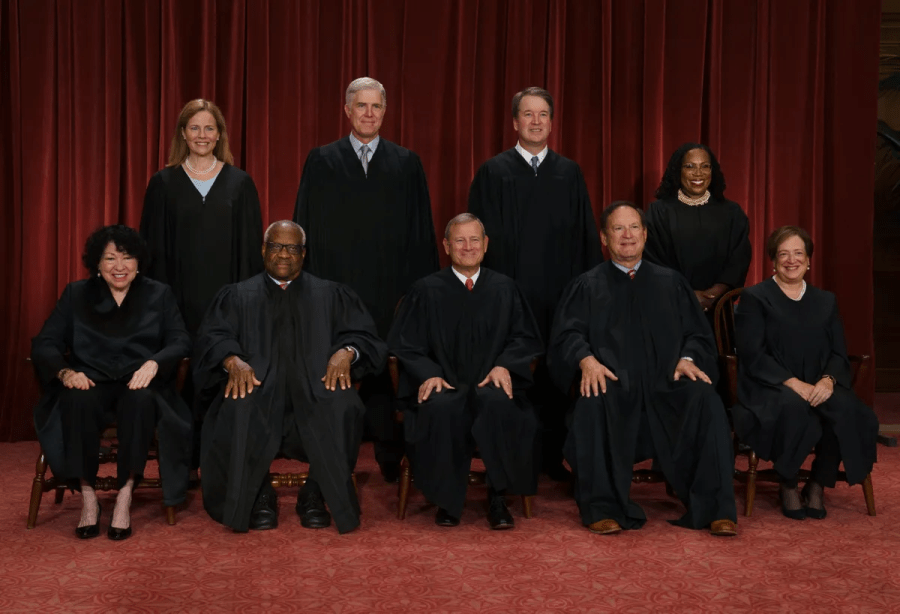
On April 22, 2026, a unanimous United States Supreme Court ruled that 887 days is 857 days too many. The 30-day deadline, Justice Sonia Sotomayor wrote for the Court, is not a suggestion. The case goes back to Michigan state court.
The decision, Enbridge Energy, LP v. Nessel, 608 U.S. ___ (2026), resolves a technical but consequential dispute about federal removal procedure. Its practical effect is to return to a Michigan judge a case that Anishinaabe tribal nations, environmental groups, and the state of Michigan have pursued for seven years. Line 5 is still operating. The pipeline has not been shut down.
What the Pipeline Is
Line 5 is a 645-mile petroleum pipeline built in 1953. It runs from Superior, Wisconsin, through Michigan’s Upper and Lower Peninsulas, and into Sarnia, Ontario, Canada. The pipeline carries up to 540,000 barrels of crude oil and natural gas liquids per day for refineries in the Midwest, Ontario, and Quebec.
A 4-mile section of Line 5 crosses the Straits of Mackinac, the channel that connects Lake Michigan and Lake Huron, by resting on the lakebed. The pipeline splits into two 20-inch pipes for that crossing. University of Michigan researchers, in a 2016 computer simulation study, found that the Straits of Mackinac is the worst location in the Great Lakes for an oil spill, due to the turbulence of the water and the difficulty of containment. Line 5 has ruptured at least 33 times since 1968, spilling more than 1.1 million gallons of oil, according to the Native American Rights Fund.
The 1953 easement was granted by the State of Michigan to Enbridge’s predecessor, the Lakehead Pipeline Company. No tribal nation was consulted. According to Bay Mills Indian Community President Whitney Gravelle, Enbridge has never consulted or sought permission from the tribes in the more than seven decades since the pipeline was built.
What Is at Stake for Tribal Nations
The Straits of Mackinac are central to the creation story of the Anishinaabe people, who identify the site as where the Great Turtle emerged to create the North American continent they call Turtle Island. Five tribal nations hold federal treaty rights to fish and hunt in these waters under the 1836 Treaty of Washington, an agreement in which the Anishinaabe ceded nearly 14 million acres of territory to the United States, keeping in exchange permanent rights to the land and waters they had used since time immemorial.
The five nations, Bay Mills Indian Community, the Grand Traverse Band of Ottawa and Chippewa Indians, the Little River Band of Ottawa Indians, the Little Traverse Bay Bands of Odawa Indians, and the Sault Ste. Marie Tribe of Chippewa Indians, all passed resolutions calling for Line 5 to be shut down. They have sought to intervene in permit proceedings and have filed briefs alongside state attorneys in court.
The tribes are not parties in Nessel’s case. They have pursued separate proceedings. Their standing as sovereign nations with enforceable treaty rights is a thread running through the broader legal conflict, though not the specific question the Supreme Court was asked to decide.
How Enbridge Got to the Supreme Court
After receiving the Attorney General’s complaint in July 2019, Enbridge chose to litigate in Michigan state court. The company argued that its operations were preempted by federal pipeline safety law, a position it has maintained throughout the litigation. It did not attempt to remove the case to federal court within the 30-day deadline.
In November 2020, more than a year after that deadline had passed, Michigan Governor Gretchen Whitmer issued a separate notice revoking the 1953 easement and filed a second lawsuit. Enbridge timely removed the Governor’s suit to federal court, arguing it raised substantial federal questions including implications for a 1977 pipeline treaty between the United States and Canada. When a federal district court agreed that federal jurisdiction was satisfied in the Governor’s case, Enbridge saw an opening.
On December 15, 2021, Enbridge removed the Attorney General’s original lawsuit to federal court. That was 887 days after receiving the complaint. The company argued that equitable principles justified allowing the late removal, because the legal landscape had changed when the district court ruled on federal jurisdiction in the Governor’s parallel case. The district court agreed. The Sixth Circuit reversed. The Supreme Court affirmed the Sixth Circuit.
What the Court Decided
The legal question was narrow: can a federal court use equitable doctrines to excuse a defendant who missed the 30-day removal deadline? Justice Sotomayor, writing for all nine justices, said no.
The opinion held that while the 30-day deadline is not jurisdictional, meaning a court retains the power to hear a case even after the deadline passes, that does not automatically make the deadline flexible. The Court examined the text and structure of the federal removal statute and found that Congress had already addressed the specific scenarios in which late removal would be allowed, listing them one by one in the statute. Those explicit exceptions, the Court found, leave no room for courts to invent additional ones through equitable reasoning.
The opinion noted that Congress gave federal courts express authority to allow late removal in criminal cases, in suits against foreign states, and in certain intellectual property and mass-fatality cases. For ordinary civil cases, Congress made no such provision. That omission, the Court wrote, was deliberate.
“Under the rule the Court adopts today,” Sotomayor wrote, “plaintiffs that sue in state court usually can be confident that, after the deadline has elapsed, the forum question has been put to rest and the case will proceed in the chosen court.” Allowing equitable exceptions, the Court held, would leave every state court case under a permanent cloud of uncertainty, generating waste and undermining congressional intent.
What Happens Next
The ruling does not shut down Line 5. It returns the Attorney General’s lawsuit to Ingham County Circuit Court in Michigan, where the case will proceed on its merits, including Nessel’s central claim that the 1953 easement is void and Enbridge’s continued operations are unlawful under Michigan law.
That case is currently stayed by stipulation of the parties. Enbridge filed a separate federal lawsuit against Governor Whitmer challenging the revocation of the easement. In December 2025, a federal district court sided with Enbridge, ruling that the Governor’s revocation was preempted by the federal Pipeline and Hazardous Materials Safety Administration’s regulatory authority. Michigan appealed that ruling. The outcome of that appeal may determine whether Nessel’s state court case can move forward independently, or whether the federal preemption question controls the outcome in both venues.
Separately, the Michigan Supreme Court is considering an appeal from tribal groups and environmental organizations seeking to overturn a state permit for Enbridge’s proposed tunnel project, which would encase the Straits crossing in a bored tunnel under the lakebed. The U.S. Army Corps of Engineers has not yet completed its environmental impact review for the same project. In Wisconsin, a federal court order requires Enbridge to shut down the segment of Line 5 that crosses the Bad River Band of Lake Superior Chippewa reservation or find an alternative route by June 2026. That order is under appeal.
Enbridge spokesperson Ryan Duffy acknowledged the ruling in a statement but emphasized that a federal court has already concluded that state regulators lack authority over Line 5’s safety. The company said the pipeline remains in compliance with federal inspection requirements and that no federal regulator has identified conditions warranting a shutdown.
Line 5 was designed to last 50 years. It is now 73 years old. It is still running.
Discover more from KVIG Informative
Subscribe to get the latest posts sent to your email.