Reporting by More Perfect Union found that industry money saturates nutrition research, lobbyists have spent decades scrubbing the words ‘eat less’ from federal guidelines, and the Trump administration’s new dietary rules were shaped by a panel where seven of nine members had financial ties to meat, dairy, or supplement industries. Beneath all of it, the actual science has barely moved since 1980.
Every few years, the federal government tells Americans how to eat. The advice seems to shift constantly. Saturated fat is dangerous. Then it is fine. Whole milk is out. Then it is back. Eggs will kill you. Then they will save you. Nutrition influencers across the political spectrum tell you the confusion is intentional, that you are being lied to by one industry or another. Reporting by More Perfect Union, a nonprofit investigative outlet, found that both things are true at once, and that the real answer is considerably less dramatic than either side admits.
The reporting, which included interviews with nutrition scientist Caitlin Dow and food industry researcher Marion Nestle, traced the corporate money flowing through the nutrition research system, the lobbying that shapes federal dietary guidelines, and the specific conflicts of interest embedded in the Trump administration’s newly released dietary advice. It also found that despite 40 years of industry manipulation, the underlying scientific consensus on what constitutes a healthy diet has changed very little.
How Industry Funds the Science
Industry money does not flow into nutrition research through obvious channels. It flows through commodity boards, trade associations, and what the agriculture industry calls checkoff programs, the same funding structures that produced the slogans “Got Milk?” and “Beef, It’s What’s for Dinner.” Those programs collect fees from producers and fund research designed to demonstrate the health benefits of their products.
Marion Nestle, a longtime food policy researcher, told More Perfect Union that every food category, every vegetable, every fruit, every nut, every grain, has research funded to demonstrate its relationship to health. That research accumulates and eventually enters meta-analyses that courts and guideline committees treat as the scientific record. Studies funded by industry find favorable results at dramatically higher rates than independent studies, the reporting found, with some reviews showing industry-funded research producing favorable results more than seven times as often as independent work. A separate review found only 6.6 percent of industry-funded studies produced unfavorable results for the sponsoring industry.
Nestle also noted to More Perfect Union that the avocado industry has funded an outsized volume of research relative to the food’s actual nutritional significance, giving avocados an elevated cultural reputation disproportionate to what independent science would support. The almonds versus muffins comparison, she said, illustrates how these studies are designed. Almonds beat muffins. The study gets published. The almond board gets a return on investment. “What a ridiculous comparison,” Dow told the outlet.
The dairy industry presents its own difficulty. Dow told More Perfect Union that nearly all research on dairy’s health effects is funded by the dairy industry, making it genuinely difficult for independent nutritionists to assess how healthy or unhealthy dairy consumption actually is. The problem is not that the findings are necessarily false. The problem is that the research agenda itself, which questions get asked and which do not, is controlled by the entities with a financial stake in the answers.
Lobbying the Language
The more consequential manipulation, Nestle told More Perfect Union, happens not in research but in the language that reaches the public through federal dietary guidelines. The food industry’s core interest is simple. It does not want any federal document suggesting Americans should eat less of its products.
That interest has driven a decades-long lobbying campaign to purge specific words from federal nutrition guidance. In 1977, the National Cattlemen’s Association successfully pressured the government to remove suggested language recommending that Americans decrease their consumption of meat. For more than a decade afterward, federal guidelines avoided synonyms of “decrease” entirely, substituting words like “choose” rather than “reduce” or “eat less.”
Since 2005, the final text of the dietary guidelines has not been written by the scientific advisory committee but by two federal agencies, the USDA and the Department of Health and Human Services, whose political appointees can be lobbied directly. The scientific advisory committee produces recommendations. Political appointees translate those recommendations into public guidance, and that translation is where industry has its most direct access.
One in four Americans eats meals based on the dietary guidelines. The school lunch program, military food, and most hospital nutrition standards follow them. The guidelines are not a lifestyle choice for most of the people they affect. They are the structural baseline of institutional food in the United States.
RFK and the New Guidelines
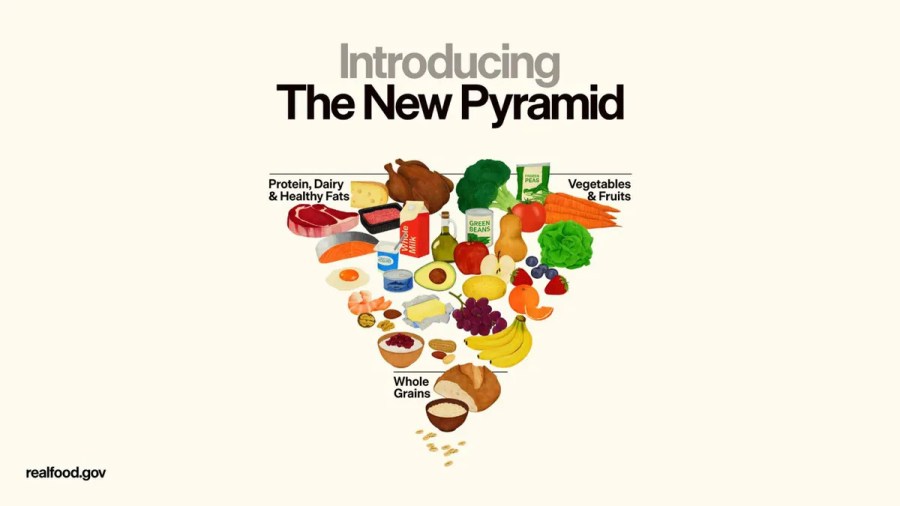
Robert F. Kennedy Jr. campaigned on eliminating conflicts of interest from federal nutrition panels. In January 2026, the Trump administration released the 2025-2030 Dietary Guidelines for Americans under HHS and USDA, marketed under the branding “eat real food” at realfood.gov. The guidelines prioritize protein at every meal, elevate dairy, and explicitly caution against ultra-processed foods and added sugars.
More Perfect Union’s reporting found that the scientific basis for those guidelines was provided by nine individuals. Seven of the nine had financial conflicts of interest with either the meat industry, the dairy industry, or the dietary supplement industry, according to the outlet’s analysis. Disclosed relationships included financial ties to General Mills, Novo Nordisk, Dannon, the National Cattlemen’s Beef Association, the National Pork Board, and the company that manufactures Atkins and Quest products.
The process that produced that panel was itself the product of industry pressure. The dietary guidelines advisory committee convened before Kennedy’s tenure had recommended emphasizing beans, legumes, and lentils as sources of lean protein. The National Cattlemen’s Association complained. Kennedy’s office discarded that report and convened a new panel. An executive of the association told reporters the new guidelines took into consideration decades of research done on beef nutrition, specifically describing it as checkoff-funded research, the marketing program funding mechanism.
STAT News, reviewing the new panel’s composition after the guidelines were released, confirmed that meat and dairy products received prime placement in the new dietary advice and that nutrition experts not aligned with industry criticism viewed the saturated fat guidance as internally contradictory. The guidelines technically retain a recommendation to limit saturated fat while simultaneously promoting full-fat dairy and increased red meat consumption. Harvard’s T.H. Chan School of Public Health described the document in January as containing “saturated fat contradictions.”
The administration’s own fact sheet declared the guidelines represent the most significant reset of federal nutrition policy in decades and framed previous guidelines as having favored corporate interests, a characterization that independent nutrition researchers applied with equal force to the new guidelines themselves.
What the Science Actually Says
Stripped of the corporate influence on both sides, what does the independent evidence show? Dow told More Perfect Union the honest answer is that the science is clearer than the noise suggests. NIH-funded controlled studies, in which research subjects were fed specific diets for extended periods under clinical conditions, produce consistent results. Butter raises LDL cholesterol significantly. Beef tallow raises it somewhat less. Olive oil lowers it. Those findings have been replicated under conditions that remove the ambiguity of observational research.
On saturated fat and heart disease, Dow said, the evidence has been accumulating for 50 years and does not depend on industry-funded studies. The complication is not whether saturated fat affects cardiovascular risk. It is that when people eat less saturated fat, they typically replace it with refined carbohydrates, which produces a wash in terms of heart health outcomes. The policy problem is behavioral substitution, not scientific uncertainty.
Nestle told More Perfect Union that the first federal dietary guidelines, issued in 1980, fit on a simple pamphlet. The core message has not changed materially since. Fill your plate mostly with fruits and vegetables. Eat whole grains. Choose lean protein. Limit added sugars, saturated fat, and salt. The perception that nutrition advice changes constantly, Dow said, is driven by media incentives for novelty, the amplifying effect of industry-funded research on specific foods, and the fact that certain industries have louder voices than others.
What does change, and what the More Perfect Union reporting makes visible, is who is shaping the translation of that stable science into public guidance, which words get used, which foods get elevated, and which industries gain or lose from the framing. The science of what to eat has been largely settled for decades. The politics of who gets to say it, and how, is a different fight entirely.
Discover more from KVIG Informative
Subscribe to get the latest posts sent to your email.