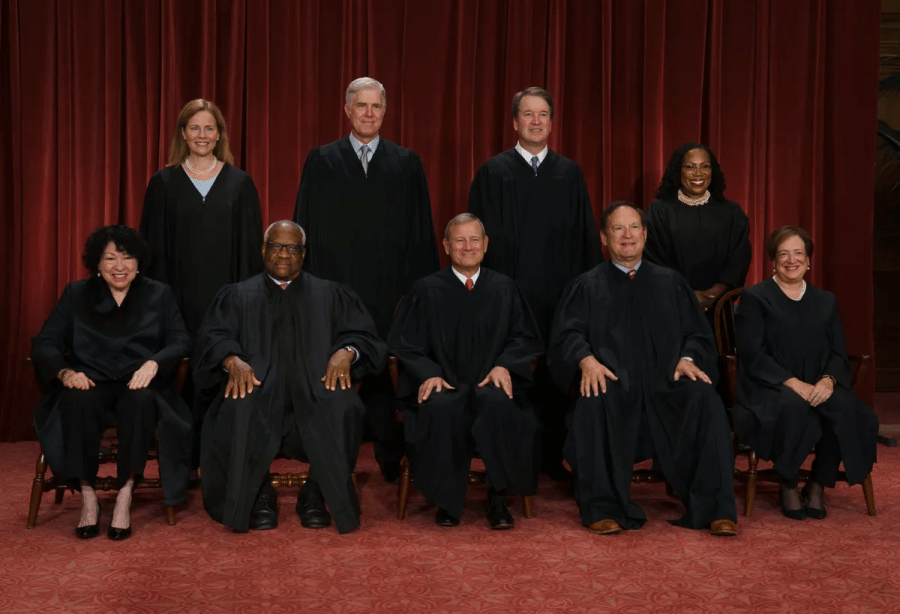
The Supreme Court heard nearly two hours of argument on April 29 over whether courts can review the Trump administration’s termination of Temporary Protected Status for 330,000 Haitians and 6,100 Syrians. The administration’s answer was no. If the Court agrees, the same logic applies to 1.3 million TPS holders from 17 countries, including thousands in Southern Nevada.
In early 2025, Walter Martinez was sitting in a strip mall office in East Las Vegas watching people disappear. They were quitting jobs, pulling children from school, refusing to leave their homes. They were TPS holders, people with legal status, legal work authorization, the right to be here, who had been told by the federal government that right was being taken away.
Martinez is secretary of Arriba Las Vegas, an immigrant worker advocacy organization in the east valley. At that point, the terminations the Trump administration had announced would affect hundreds of thousands of Venezuelans nationally. In Las Vegas, where the construction and hospitality industries have relied on immigrant labor for decades, the chilling effect was immediate. In the months since, the terminations have expanded. Honduras ended September 8, 2025. Afghanistan ended July 21. Nepal ended August 20. The list keeps growing.
On April 29, 2026, the last scheduled argument day of the Supreme Court’s 2025-26 term, nine justices heard nearly two hours of argument on whether any of it is reviewable by a court at all. The cases are Mullin v. Doe and Trump v. Miot. A decision is expected by late June. What the Court decides will shape immigration law, executive power, and the lives of the roughly 1.3 million people currently holding TPS from 17 countries.
What TPS Is and Why It Matters Here
Temporary Protected Status was created by Congress in 1990 as a humanitarian tool. When conditions in a country, active armed conflict, natural disaster, or extraordinary emergency, make it unsafe to return, the Secretary of Homeland Security can designate that country for TPS. Nationals from that country already living in the United States receive a temporary legal status, the right to work, and protection from deportation. The designation is reviewed every 6 to 18 months and can be extended or terminated based on current country conditions.
As of March 2025, there were approximately 1.3 million TPS holders in the United States from 17 countries. In Southern Nevada, the affected communities include significant numbers from El Salvador, Honduras, Venezuela, and Haiti. TPS holders work in construction, hospitality, healthcare, and service industries throughout Clark County. El Salvador’s TPS runs through September 9, 2026. If the administration terminates it, many of those holders would have no legal status remaining.
Haiti’s TPS designation dates to 2010, following the earthquake that killed an estimated 220,000 people. Syria’s began in 2012, at the outbreak of civil war. The State Department currently issues Level 4: Do Not Travel advisories for both countries, citing ongoing violence, terrorism, and severely limited access to basic services. DHS Secretary Kristi Noem terminated both programs in late 2025, declaring that conditions had improved and that continuation was contrary to the national interest. Noem was replaced by Markwayne Mullin as DHS Secretary in March 2026, giving the case its current name.
What the Administration Argued
Solicitor General John Sauer opened the argument for the Trump administration with a position that surprised no one who had followed the litigation. The TPS statute, he told the Court, bars judicial review of any determination of the Secretary with respect to the designation or termination or extension of a TPS designation. That provision means what it says. Any step in the termination process, any procedural requirement the Secretary skipped or rushed, is unreviewable by any federal court.
Justice Sotomayor pressed Sauer directly. She asked him to confirm that even if the Secretary had announced a TPS termination on social media with no notice, no Federal Register publication, no 60-day warning to holders, no consultation with other agencies, none of the procedural requirements Congress wrote into the statute, he would say a court could not review that. Sauer confirmed. That’s correct, he said.
Sotomayor was direct in her response. “You’re saying that Congress wrote a statute for no purpose,” she told him, because it set forth procedural steps that had to be followed and made them entirely unenforceable. Sauer maintained that Congress balanced those risks when it wrote the judicial review bar, and that the executive branch could be trusted to follow the statute without court supervision. Congressional oversight through annual reporting requirements, he said, was the appropriate check. Justice Kavanaugh pointed out that annual reports come after the fact, after status has already been stripped.
Chief Justice Roberts noted that Sauer was relying on Trump v. Hawaii, the 2018 travel ban case, but that case involved the President and entry restrictions for people seeking to come to the country. Here the question was about people already lawfully present under a congressionally created status. Sauer’s argument, Roberts said, was a significant expansion of that precedent. Sauer maintained it applied across contexts.
The Race Question
Geoffrey Pipoly, representing the Haitian TPS holders in Trump v. Miot, brought the most direct argument in the courtroom. The termination of Haiti’s TPS, he told the justices, was not the result of the mandatory review process. It was a preordained result driven by the President’s resolve to end TPS for Haiti regardless of what country conditions showed. DHS documents lodged with the Court showed that agency staff were forced to include rationales for termination that had no empirical support.
Pipoly named the evidence. Trump had described Haitian TPS holders as undesirables from a country he referred to with an expletive. Days after falsely accusing Haitian immigrants in Springfield, Ohio, of eating pets, he vowed to terminate Haiti’s TPS. That termination followed. Secretary Noem had publicly described people from Haiti and 18 other countries as killers, leeches, and entitlement junkies, saying we don’t want them, not one, while simultaneously creating a new humanitarian relief pathway for white South Africans under a separate program.
Justice Kagan asked Pipoly to clarify the racial claim. She noted the administration had moved to terminate all 13 TPS designations that had come up for review, not just Haiti. If all TPS programs were being eliminated, how did race drive that? Pipoly’s response, which Justice Jackson sharpened, was that all 17 designated TPS countries are countries with predominantly non-white populations. The motivation for eliminating the TPS program broadly, Pipoly and Jackson agreed, was that the program as a whole benefited non-white people. Under Arlington Heights, racial motivation need only be one of many factors driving a policy decision for equal protection scrutiny to apply.
Justice Thomas asked how equal protection applied here at all, given that the clause is in the Fourteenth Amendment and constrains states. Pipoly responded that the Fifth Amendment’s due process clause has long been held by the Court to contain an equal protection component that constrains the federal government in the same way. Sotomayor confirmed from the bench: the Fifth Amendment bars the federal government from discriminating on the basis of race.
The Procedural Stakes
Ahilan Arulanantham, arguing for the Syrian plaintiffs, told the Court the administration was asking it to read the TPS statute as a blank check. The Secretary could designate every country on earth for TPS to provide mass immigration relief, and under the government’s logic, courts could do nothing. The same unreviewable discretion the administration was claiming to end TPS could be used to expand it without limit. That, he said, contradicts the text, bedrock administrative law, and common sense.
On the statutory text, Arulanantham argued that the judicial review bar covers determinations in subsection (b) of the statute, the country conditions assessments. It does not cover the procedural obligations written elsewhere in the statute, including the requirement to consult with the State Department and other agencies before terminating. He pointed to an email chain showing Noem’s consultation with State consisted of a single short email each way that did not discuss country conditions at all. That, the plaintiffs argued, was not consultation in any meaningful sense.
Justice Jackson articulated the core conceptual tension clearly. If Congress wrote a statute requiring the Secretary to take certain steps, and those steps are entirely unenforceable, then the Secretary can basically do whatever she wants. Sauer’s response, delivered twice, was: Congress assumed that risk when it wrote the judicial review bar.
What Nevada Faces
The Court’s ruling will not be limited to Haiti and Syria. Plaintiffs and legal analysts told reporters after argument that the decision on the judicial review question will apply across all pending TPS cases. El Salvador’s TPS for approximately 250,000 holders expires September 9, 2026. If the administration terminates it and the Court holds such decisions are unreviewable, there is no legal mechanism left to challenge it.
In Southern Nevada, Arriba Las Vegas and other immigrant advocacy organizations have been tracking the effects since early 2025. Francis Garcia, an organizer with Arriba who came from Honduras in 1996 and faces a TPS deadline, told a local corporate outlet in March 2025 that during the first Trump term, people thought the only solution was going back, or leaving the country. She said the same fear had returned, magnified by the speed and scope of the current terminations.
The hospitality and construction sectors that anchor the Las Vegas economy depend substantially on immigrant labor. The Nevada Resort Association has not taken a public position on the TPS litigation. The Nevada AFL-CIO and Culinary Local 226 have both expressed support for TPS holders in the state, though neither has joined the federal litigation directly.
Krish O’Mara Vignarajah, president and CEO of Global Refuge, a national refugee resettlement nonprofit, told reporters before argument: “TPS is not a loophole. It is Congress’s deliberate answer to the question: what do we do when war, environmental disasters, or humanitarian catastrophe makes returning safely impossible?” The Supreme Court will answer, by late June, whether anyone other than the executive branch gets to ask that question.
Discover more from KVIG Informative
Subscribe to get the latest posts sent to your email.