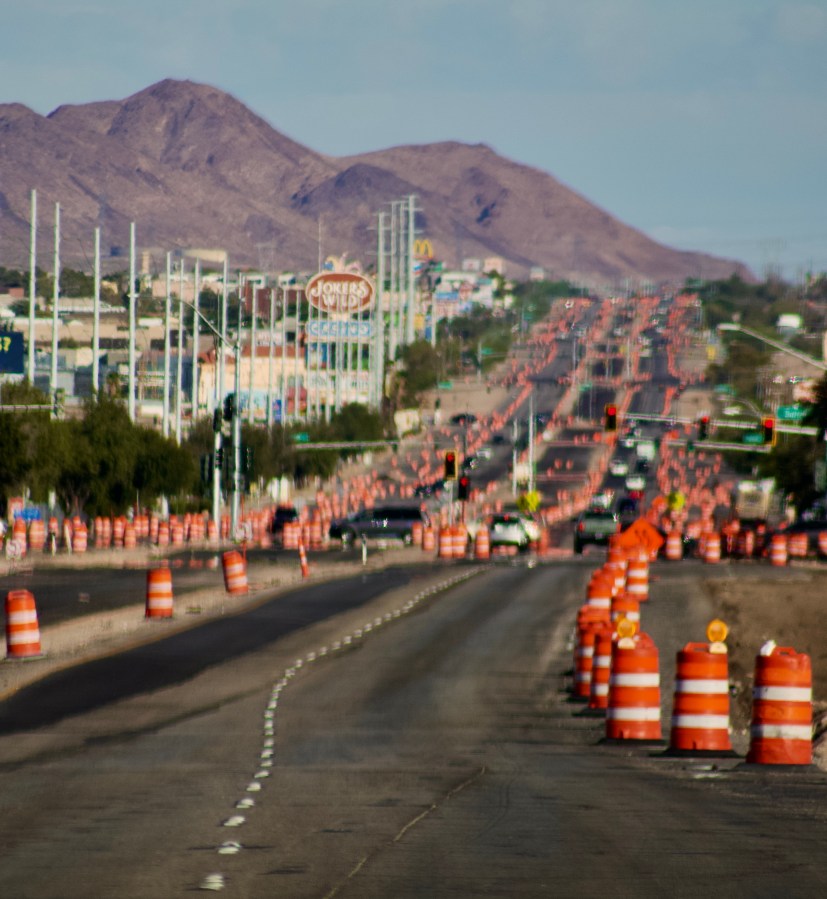
Henderson is spending $184 million to rebuild its 7.5 miles of Boulder Highway into a multimodal corridor with bike lanes, wide sidewalks, and a center bus rapid transit system. Clark County’s answer for its unincorporated stretch of the same road is $504,000 worth of chain-link fence. The people dying on the Clark County side are poorer, browner, and further from a congressional representative willing to fight for them.
Boulder Highway is 15 miles long.
It runs from downtown Las Vegas south through unincorporated Clark County and into Henderson before terminating near Boulder City.
For most of its life it was called the deadliest road in Nevada. It was built in 1931 to carry construction workers to the Hoover Dam site and never properly redesigned for the urban corridor it became.
In 2021, the City of Henderson secured $39.9 million in federal funding to fix its 7.5-mile stretch. That money became the anchor for a $184 million overhaul now past the halfway point.
On the Clark County side, which covers the stretch from roughly Flamingo Road north toward Desert Inn and Sahara Avenue, the response has been chain-link fence in the median.
The people on both sides of that jurisdictional line are dying on the same road. The money being spent to protect them is not the same.
What Henderson Built
The Reimagine Boulder Highway project broke ground in summer 2024 and is scheduled for completion in 2027.
The $184 million project reduces traffic lanes from six to four, adds elevated bike lanes on both sides of the road, widens sidewalks, installs lighting along the full stretch, and builds a center-running bus rapid transit lane on a raised red platform.
It also includes storm drainage improvements addressing chronic flooding near Lake Mead and Sunset.
As of January 2026, the project had passed the halfway mark. Workers had logged more than 154,000 hours on the job. The Regional Transportation Commission added $12 million to the original $172 million budget in late 2025 to cover additional transit shelters.
The federal grant that started it all, $39.9 million from the U.S. Department of Transportation’s Infrastructure for Rebuilding America program, was secured by then-Rep. Susie Lee and Sen. Catherine Cortez Masto, who personally appealed to Transportation Secretary Pete Buttigieg on Henderson’s behalf.
Henderson’s public works director said at the time that the city expected full funding and construction by 2023. They got it. Between federal funding and state fuel tax revenue, the city assembled nearly $80 million before even approaching the Regional Transportation Commission for the rest.
What Clark County Built
In October 2024, Clark County’s Department of Public Works installed 1,500 feet of chain-link fence in the median of Boulder Highway between Flamingo Road and Nellis Boulevard.
The fence cost $41,285. It was installed at the request of LVMPD’s Southeast Area Command Captain Jeff Clark, who wanted to prevent pedestrians from crossing mid-block.
The results were real. Before the fence, that stretch averaged five pedestrian deaths per year. In the two years since installation, that number dropped to zero, according to Captain Clark.
In April 2026, Clark County approved a $504,000 expansion project to add 6,000 more feet of fencing between Desert Inn Road and Flamingo Road. Construction began in early April and is expected to finish by the end of June.
The project includes chain-link fencing, permanent safety signage, and additional infrastructure enhancements.
Clark County Commissioner Tick Segerblom acknowledged the optics directly at a May 10 media event.
“This is not a beautification project,” Segerblom told reporters. “If you look at the distance between stop lights, it’s crazy over here, because this road was built a long time ago. The speed is so high, the lighting is low and the history is there. It’s the most dangerous highway in the state.”
Captain Clark, who came up with the fence idea, also acknowledged the community context without prompting.
“This is a part of the valley that gets neglected often when it comes to policing and other things,” Clark told reporters. “That was not acceptable to me to see the death and the destruction that I was having along Boulder Highway.”
Who Lives Here
Sunrise Manor is the unincorporated community that sits alongside the Clark County stretch of Boulder Highway. It has a population of approximately 201,000 people, making it larger than Reno.
It has never been incorporated. It has a Town Advisory Board with no governing authority.
Its poverty rate is 20.2 percent, well above the national average of 12.5 percent and the Clark County average of 13 percent.
Its median household income is approximately $58,421. Approximately 27 percent of its residents were born outside the country.
The largest demographic group living below the poverty line in Sunrise Manor is Hispanic, followed by White and Black residents, according to Census data.
Clark County’s own economic analysis has ranked Sunrise Manor among the most economically distressed of its unincorporated communities, alongside Winchester and Laughlin.
The Nevada Current documented as far back as 2019 that pedestrian deaths in the region disproportionately occur in lower-income, minority communities located around roadways built to move vehicles quickly.
Eastern Las Vegas had the longest average school commute times in the region at 18.8 minutes, indicating a lack of personal vehicles and a higher dependence on transit and walking, according to that analysis.
These are the people crossing Boulder Highway mid-block. They are crossing because the crosswalks are spaced too far apart, because the buses they depend on stop on the other side, and because the road was designed for cars traveling to the Hoover Dam, not for people walking to a grocery store.
The Funding Gap
The disparity is not just symbolic. It reflects how infrastructure funding flows through jurisdictional channels that reward incorporated cities over unincorporated communities.
Henderson, as an incorporated city, has a dedicated public works department, a city council that can authorize bonding, and an established relationship with federal grant programs. It can apply directly to the Department of Transportation for competitive INFRA grants.
Unincorporated Clark County does not have the same direct access to those competitive grant pipelines. It depends on the Clark County Commission, the Regional Transportation Commission, and state-level funding allocations.
When Henderson’s congressional representatives lobbied the DOT for $40 million, they pointed to a specific city, a specific project, a specific engineering plan, and a specific community that would benefit.
The Clark County stretch of the same road has no comparable champion with the same institutional capacity to make that case in Washington.
The Las Vegas Sun editorial board noted in 2021 that ideally the entire 15-mile stretch of Boulder Highway could be upgraded uniformly from end to end. The Sun described the collaboration between Henderson, Clark County, NDOT, and the RTC as good governance.
The collaboration produced $184 million for Henderson. It produced $504,000 in chain-link fence for Sunrise Manor.
The Death Toll
Boulder Highway has accounted for approximately 9 to 10 percent of all statewide pedestrian deaths for years, according to Henderson’s own public works director and the Nevada Department of Public Safety.
A map of pedestrian deaths in Clark County since 2017, cited by local press, shows dots forming a clear line along the full length of Boulder Highway, with heavy concentration on both the Henderson and Clark County segments.
In the first half of 2024 alone, pedestrian deaths in Clark County rose 53 percent compared to the same period in 2023, reaching 52 deaths from January through June.
In April 2024, on the Clark County stretch near a bus stop on Boulder Highway, a suspected drunk driver struck a family of five traveling northbound in the southbound lanes. A father and his teenage son were killed. Three others were injured.
In January 2026, an unhoused man was struck and killed on Boulder Highway. His death was the eleventh traffic-related fatality in LVMPD’s jurisdiction in the first 29 days of that year.
Erin Breen, director of UNLV’s Road Equity Alliance Project, has consistently pointed to road design, not pedestrian behavior, as the primary driver of these deaths.
“Making a commitment to eliminating fatal and serious injuries on the nation’s roadways will require robust investment,” Breen told the Las Vegas Sun in 2025.
The fence reduces deaths in the specific stretch where it is installed. It does not fix the spacing of crosswalks. It does not add lighting. It does not slow traffic. It does not widen sidewalks. It does not add a bus rapid transit lane.
It redirects people toward crosswalks that are already there. Henderson is building new ones.
What Comes Next
Henderson’s project is on track for a 2027 completion. When it is done, its 7.5 miles of Boulder Highway will have wider sidewalks, protected bike lanes, a bus rapid transit system, improved drainage, and full street lighting.
The remaining 7.5 miles of Boulder Highway, which run through unincorporated Clark County and the city of Las Vegas, are described by Henderson’s city engineer as a future collaboration between the RTC, Clark County, and the City of Las Vegas.
No funding has been publicly committed for that collaboration. No construction timeline has been announced. No federal grant application is on record.
Clark County’s $504,000 fencing project is expected to finish by the end of June 2026.
The road will still be six lanes wide. The speed limit will still be 45 miles per hour in some stretches. The crosswalks will still be spaced far apart. The lighting will still be inadequate at night.
And the people of Sunrise Manor will still be crossing it.
Discover more from KVIG Informative
Subscribe to get the latest posts sent to your email.