Sunrise Manor is home to more than 190,000 people and has no mayor, no city council, and no independent budget. Its advisory board cannot levy a tax, sign a contract, or override a single decision made by the Clark County Commission. That absence of power is not a footnote. It is the mechanism by which the neighborhood’s parks, sidewalks, and green space keep losing to every other priority in a county that spans 8,061 square miles.
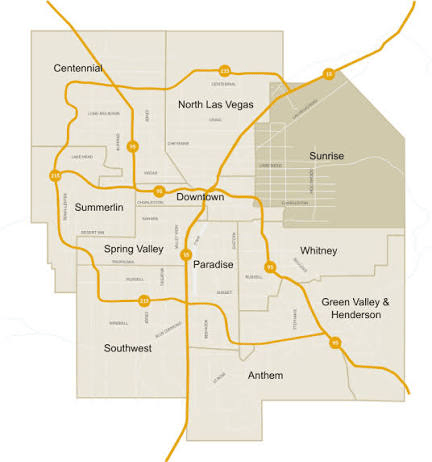
Sunrise Manor covers 46 square miles in the northeast part of the Las Vegas Valley. It is home to more than 190,000 people. It has never had a mayor.
It was created as an unincorporated town by Clark County Ordinance No. 495, adopted August 17, 1973. Everything that has happened to its infrastructure since traces back to what that ordinance did and did not give the community.
It gave residents a Town Advisory Board. It did not give them a government.

3×3 Vinyl Sticker
Sliding scale $3.00-$8.00

3×3 Vinyl Sticker
Sliding scale $3.00-$8.00
What the Board Can Actually Do
Five people sit on the Sunrise Manor Town Advisory Board. The Clark County Board of Commissioners appoints all five. They serve without compensation.
Under Nevada Revised Statutes Chapter 269 and the board’s own bylaws, its purpose is to assist the Board of County Commissioners in governing the unincorporated town by acting as a liaison between residents and the county, and to advise the commission on matters of importance to the town.
Advise. That is the operative word in the statute. The board can recommend. It cannot decide.
It cannot levy a tax. It cannot issue a bond. It cannot sign a contract. It cannot hire staff. Under NRS 269.030 through 269.040, the actual financial and administrative functions for the unincorporated town, the treasury, the legal enforcement, the contracting, are handled entirely by county officers: the county treasurer, the county clerk, the district attorney.
The board meets once a month at the Hollywood Recreation Center. Any item not already on the agenda cannot be acted on. A county staff liaison sits in every meeting as the administrative bridge between the community and the commission that actually controls its infrastructure budget.
That is the extent of Sunrise Manor’s self-governance. A monthly meeting, an agenda controlled by county staff, and a recommendation that the seven-member Board of County Commissioners is free to accept, modify, or ignore.

3×3 Vinyl Sticker
Sliding scale $3.00-$8.00

3×3 Vinyl Sticker
Sliding scale $3.00-$8.00
One Vote Among Many
Clark County’s unincorporated area is not a marginal part of county government. It is close to half of it.
Nearly one million residents live in unincorporated Clark County, close to half the county’s total population of more than 2.3 million, according to Census data. Sunrise Manor, Whitney, Winchester, Paradise, Spring Valley, Enterprise, and every other unincorporated community share that status.
All of them are governed by the same seven-member Board of County Commissioners. That commission does not govern Sunrise Manor alone. It governs the Strip. It governs the airport. It governs the convention center. It governs a jurisdiction of 8,061 square miles, one of the largest county governments in the United States by population and geography.
Each of the seven commissioners represents a district. Sunrise Manor’s interests move through whichever commissioner represents that district, competing for attention and dollars against every other constituency and capital priority in that commissioner’s district, and then against six other districts’ priorities when the full commission sets the countywide budget.
Henderson, by contrast, has its own mayor, its own city council, and its own budget authority. When Henderson decides its residents need a $184 million rebuild of Boulder Highway with protected bike lanes, its own council can commit to that project, apply for federal grants under its own name, and bond against its own future revenue. Sunrise Manor cannot do any of that on its own behalf. Every dollar has to clear the county’s full budget process first.

3×3 Vinyl Sticker
Sliding scale $3.00-$8.00

3×3 Vinyl Sticker
Sliding scale $3.00-$8.00
Where the Money Actually Goes
Clark County’s Capital Improvement Program is enormous. The Fiscal Year 2027-2031 program alone projects $5.39 billion in expenditures over five years, according to the county’s own published overview.
That budget is organized by function across the entire county, not by unincorporated town. Regional flood control, regional transportation, parks, roads, water reclamation, and general government facilities are funded as countywide or regional line items. Sunrise Manor does not have its own capital account. It has a share of Clark County’s, decided through the same commission that decides everyone else’s share.
The county’s own economic development office has documented what that structure produces. Clark County’s Office of Community and Economic Development, in its Mapping the Future report, found that unincorporated areas are in general more economically distressed than incorporated areas and that Sunrise Manor specifically carries one of the higher concentrations of that distress, with a poverty rate of 20.2 percent.
The county’s own maintenance inventory for Public Works still lists gravel roads and gravel shoulders as active categories of infrastructure it maintains in the unincorporated valley. That designation exists in 2026, inside the urban core of one of the largest metropolitan areas in the country, in a community with no independent authority to change it.

3×3 Vinyl Sticker
Sliding scale $3.00-$8.00

3×3 Vinyl Sticker
Sliding scale $3.00-$8.00
The Park Deficit
Green space is not a decoration. It is a documented determinant of mental health outcomes, and the research on that point is extensive.
A systematic body of peer-reviewed research, including studies published through the National Institutes of Health’s PubMed Central database, has found that exposure to green space is associated with lower rates of stress, depression, and anxiety, and that neighborhood greenspace visits show a measurable association with better mental health, an association that researchers found to be particularly salient in high-density areas where exposure to stressors and social vulnerability is greater.
A 2024 meta-analysis published in Environmental Research found that green space affects mental health through multiple channels: reducing air and noise pollution, encouraging physical activity and social interaction, and directly lowering the physiological stress response. The World Health Organization has estimated more than 260 million people worldwide suffer from depression and 300 million from anxiety disorders, conditions the research consistently links to environmental and neighborhood-level factors including green space access.
The Centers for Disease Control and Prevention has stated plainly that exposure to green space, even in a limited setting such as a residential city park, carries positive physical and mental health benefits including lower rates of heart disease, stroke, obesity, stress, and depression.
Sunrise Manor’s park acreage per capita trails both the incorporated City of Las Vegas and the City of Henderson, according to Clark County Parks and Recreation data referenced in prior KVIG reporting on valley-wide infrastructure. Summerlin, by comparison, was built with more than 200 miles of trails and parks integrated into the community from its founding in 1990 by the Howard Hughes Corporation, a private developer with the capital and planning authority to build that infrastructure before a single house was sold.
Sunrise Manor was never master-planned that way. It grew as an unincorporated community whose green space, where it exists, was added reactively through a county capital budget process that a five-person advisory board with no governing authority can only ask the county to consider.


The Compounding Effect
None of these gaps operate in isolation. A community with fewer parks has fewer places for physical activity, which the CDC and multiple peer-reviewed studies link directly to worse mental health outcomes. A community with broken sidewalks and gravel shoulders has fewer people walking or cycling at all, cutting off the exposure to green space and physical activity that the research identifies as protective.
A community whose infrastructure decisions are filtered through a governance structure with no direct electoral accountability, no independent budget, and no enforcement power has no fast path to correct any of it. The Town Advisory Board can pass a recommendation. It cannot make the county build a park.
Compare that to Henderson, where a resident dissatisfied with a park or a road can vote for a different city council member in the next municipal election, and that council member has direct authority over a dedicated city budget. In Sunrise Manor, the nearest equivalent accountability runs through a county commissioner who also answers to the Strip, the airport authority, and six other commission districts.
The distance between a resident’s vote and an actual infrastructure decision is not a small technicality. It is the entire difference between a governance system built to respond to a neighborhood and one built to average that neighborhood’s needs against a jurisdiction the size of a small U.S. state.

What the Law Allows That Has Not Happened
Nevada law does provide a path for unincorporated towns to gain more authority. NRS Chapter 269 lays out methods for the formation of towns with elected town boards, which under NRS 269.0242 can include appointment or election provisions and, further into the statute, options for town boards with expanded budgetary participation under NRS 269.590, which addresses a town board’s participation in budget and ordinance decisions for the town.
Sunrise Manor has not pursued that path. Its Town Advisory Board remains appointed, not elected, and advisory, not governing. Changing that status would require action by the Board of County Commissioners, the same body whose authority such a change would diminish.
Incorporation, the process by which an unincorporated community becomes its own city with its own mayor and council, is legally possible under Nevada law but has not been pursued for Sunrise Manor. It would require a level of organized political mobilization, legal process, and fiscal independence that a community without an independent government has historically struggled to generate precisely because it lacks an independent government.
That is the loop. The structure that produces the infrastructure deficit is the same structure that makes it hardest to organize a fix.
What This Means
More than 190,000 people live in Sunrise Manor. They pay Clark County property taxes. They pay the same sales tax rates as Henderson residents. They generate revenue for a county government that oversees one of the largest tourism economies in the country.
What they do not have is a mayor to call, a council member who answers only to them, or a budget they can see itemized and specific to their streets. What they have is a five-person advisory board that meets once a month, cannot act outside its agenda, and exists to advise a commission that governs a jurisdiction where Sunrise Manor is one voice among nearly a million unincorporated residents and more than two million countywide.
The research on green space and mental health is not ambiguous. Access matters. Proximity matters. The physical presence of a maintained park, a safe sidewalk, a protected bike lane, measurably changes stress, depression, and anxiety outcomes for the people who live near it.
Sunrise Manor’s governance structure was built in 1973 to advise, not to decide. Fifty-three years later, the parks, the sidewalks, and the roads still reflect exactly that limitation.
Discover more from KVIG Informative
Subscribe to get the latest posts sent to your email.